HIPAA Compliance Requirements for AI Medical Billing Platforms
HIPAA compliance for AI billing tools requires layered safeguards, not vendor checkboxes.
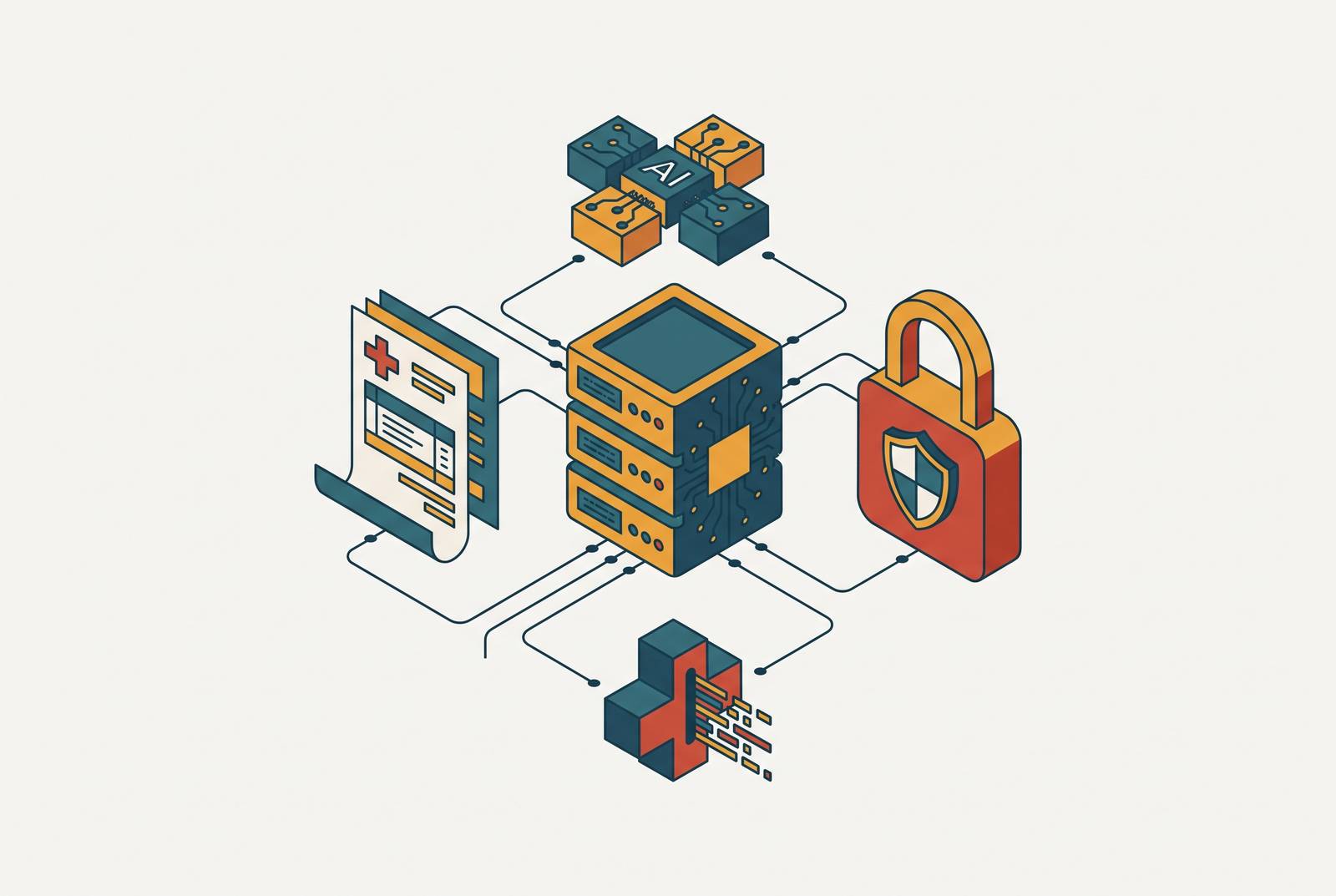
HIPAA compliance for an AI medical billing platform is not a checkbox a vendor checks once. It is a layered set of obligations, spanning administrative policy, physical safeguards, and technical infrastructure, that both the billing practice and the vendor have to build and keep maintaining. Asking a vendor "are you HIPAA compliant?" is a fair opening question, but it invites a yes-or-no answer to a problem that never resolves into a yes or no. A federal health-privacy law was written in 1996 and updated through the HITECH Act in 2009, decades before anyone was routing patient claims through a language model, and the law's structure still shows that gap. The same AI system can be fully compliant in one deployment and a violation waiting to happen in another, depending on where it runs, who can query it, and whether the paperwork behind it was ever signed. The HIPAA Journal's 2026 data breach report put the number of people affected by healthcare breaches in the prior year at roughly 139.7 million, a plain enough signal that misconfigured or under-governed AI in billing workflows is not a hypothetical worry.
What PHI actually means in a billing context and why AI expands its scope
Protected health information is any individually identifiable health data that a covered entity or its business associate creates, receives, stores, or sends along. HHS lists 18 specific identifiers that trigger this status, and in a billing office, nearly everything that crosses a desk qualifies: patient demographics, insurance ID numbers, diagnosis codes attached to a name, claims data, prior authorization records, payment histories. Each of those details is deliberate. It is the entire raw material of the job.
Most AI billing tools operate under the "payment" provision found in 45 CFR 164.501, the legal basis covering billing, claims management, denial handling, and prior authorization work. That provision comes bundled with the minimum necessary standard: an AI system doing claims work should only touch the fields it needs for that specific task, not the full patient record. Vendors that pull the whole chart because it's easier to build the pipeline that way are already out of line with the standard, whether or not anyone notices yet.
Re-identification remains the harder problem, one that most practices haven't caught up to. HHS guidance from 2024 acknowledged that modern AI systems, especially large language models, may be able to re-identify data that was stripped of identifiers under the Safe Harbor method, simply by cross-referencing it against outside data sources the model has access to. A de-identification approach that was airtight in 2015 does not carry the same guarantee once an AI model with a broad training corpus is doing the processing. So a practice stripping obvious identifiers before handing records to a billing tool cannot assume that step alone satisfies HIPAA anymore. Both paths to de-identification under the law, Safe Harbor and Expert Determination, need a fresh look whenever AI is the system doing the handling.
The Business Associate Agreement as the legal foundation of any AI billing relationship
Any AI billing vendor touching PHI is a business associate under HIPAA, full stop. That status carries a legal duty to sign a Business Associate Agreement and to meet the Security Rule's safeguards, and no amount of encryption or access control downstream makes up for a missing BAA. It is the floor everything else sits on, and a vendor that hedges on signing one has already told a practice everything it needs to know.
A proper BAA spells out what the vendor may do with PHI, its obligation to keep safeguards in place, how fast it has to report a breach, what its subcontractors are bound to, and what happens to the data when the contract ends. With AI vendors specifically, a few questions matter more than they used to. Is patient data used to train or refine the vendor's models, and if so, is that use spelled out and authorized rather than buried in a terms-of-service update? Are the subprocessors behind the platform, the cloud host, the clearinghouse, the model provider, covered by their own downstream BAAs? What's the vendor's actual breach notification window, measured against HIPAA's breach notification requirements? And does the agreement say anything about what happens to data retention and access when the underlying model gets updated or replaced?
The Office for Civil Rights closed over 500 settlements in 2024, and a good number traced back to billing vendors mishandling electronic PHI. The agency has actually been spending its attention on this concrete enforcement risk. And the liability does not transfer with the signature. A practice remains on the hook for choosing and overseeing its business associates even when the associate is the one that made the mistake. Blaming the vendor after the fact has never once worked as a defense in front of OCR.
The five technical safeguards that define whether an AI billing platform's infrastructure is defensible
Five things have to be in place before an AI billing platform's technical foundation holds up: encryption, access controls, audit logging, vulnerability management, and data minimization. Skip any one of them, and no amount of AI sophistication makes up the difference. Vendors love to talk about their model's accuracy or speed; ask about these five first, because none of the rest matters if they're missing.
Encryption comes first, and it has two halves that both need covering. Data has to be encrypted in transit, using TLS 1.2 or better, and at rest, using AES-256 at minimum. Covering only one leaves the other stage exposed, which defeats the purpose entirely. Encryption is technically still an "addressable" safeguard under the current Security Rule, meaning a covered entity could argue its way out of it on paper, but a 2025 HHS proposal would make it mandatory outright. Treat it as required today. Waiting for the rule to catch up is not a strategy, it's a delay tactic dressed up as one.
Access control is where minimum necessary gets enforced in practice, through role-based access control and unique user IDs, with multi-factor authentication sitting alongside as its own separate safeguard. The 2025 proposed rule would mandate MFA across every point where ePHI is accessed, billing portals included. For an AI agent, access control means something slightly different: it governs what data the model can actually pull at the moment it's running, not just what a human logged into the system is allowed to see. A scheduling agent has no business reading clinical notes. A claims agent should only reach the PHI its specific task calls for, nothing broader, and if a vendor can't explain how that boundary is enforced at runtime rather than just described in a policy document, the boundary probably doesn't exist.
Audit logging has to be immutable, and it has to record who touched which record, when, and what they did next. For an AI agent, that log needs to extend to the agent's own decisions: which records it pulled, which tools it invoked, what it did with what it found. Without that trail, there's no way to review the agent's behavior after the fact, and that traceability is exactly what an OCR audit is checking for.
Vulnerability management under the 2025 proposed rule would require regular scanning and periodic penetration testing, with disaster recovery plans specifying defined restoration timelines for critical systems following a loss event. Even certified, enterprise-grade tools aren't immune to gaps: Microsoft's HIPAA-compliant Health Bot needed an emergency patch in 2024 for a privilege vulnerability that could have allowed lateral movement into other resources. The tool itself was not unsafe. Continuous patching is part of the job, not a one-time certification a vendor earns and then coasts on.
Data minimization sits in real tension with how AI systems tend to work, since more data usually means better model performance, and HIPAA's minimum necessary standard pulls the other direction. That tension doesn't get resolved by a vendor's marketing copy. Practices should be asking vendors to document, function by function, which categories of PHI each AI feature actually needs, and how the system enforces that boundary while it's running, not just on paper.
Administrative safeguards: what the practice itself is required to maintain, not just the vendor
None of the above lets a practice off the hook. Administrative safeguards belong to the covered entity, not the vendor, and they don't shrink just because the billing work runs through someone else's AI platform. This is the part practices most often get backwards: they treat a vendor's compliance documentation as a substitute for their own risk analysis, and it isn't one.
A practice using an AI billing tool needs a documented risk analysis that specifically addresses how that AI interacts with ePHI. The Security Rule covers ePHI wherever it appears in a regulated entity's systems and workflows. Beyond that, a practice needs policies stating which AI applications get access to PHI and which categories each one needs, staff training on phishing and social engineering aimed at billing departments (still one of the more common ways breaches start), and a documented breach response procedure that accounts for HIPAA's breach notification requirements, including timely reporting to HHS.
An assessment found that 67% of healthcare organizations were not ready for stricter HIPAA security standards. That number says something uncomfortable about how many risk analyses on file haven't been updated to reflect what AI deployment actually changes, which in most cases is: nobody touched the document once the vendor contract was signed. Any time a practice adopts a new AI billing tool or switches vendors, that risk analysis needs revisiting. It isn't optional, and it isn't a one-time exercise.
Physical safeguards still apply too, even when most of the billing work happens in the cloud: server room access controls, workstation policies for billing staff, rules for portable devices that touch ePHI. Practices should also build in the contractual right to audit a billing partner's compliance posture directly, requesting proof of vulnerability scans, penetration test results, and training records rather than taking a vendor's word for it. A vendor that resists that audit right is telling you something.
How the 2025 HHS proposed Security Rule updates change the compliance calculus for billing platforms
HHS published proposed updates to the Security Rule in January 2025, representing a substantial revision to the existing framework. For AI billing platforms, a handful of the proposed changes matter more than the rest. Encryption moves from addressable to required, closing off the risk-based opt-out that some vendors have leaned on for years. MFA becomes mandatory across every ePHI access point, including billing portals and API connections. Vulnerability scanning would be required at least twice a year, penetration testing on a regular periodic basis, and disaster recovery plans would need to specify restoration of critical systems within 72 hours. strong encryption for data at rest, with AES-256 representing the recognized industry standard, would move closer to a firm requirement rather than a recommendation.
Several safeguards that vendors currently treat as optional are headed toward becoming legal requirements. That means any vendor selling a compliance posture built around the current, looser floor is selling something that won't hold up much longer, and a practice signing a multi-year contract on that basis is buying a problem it will have to renegotiate. Practices renewing or evaluating AI billing contracts now should measure vendors against the proposed rule, not the rule as it stands today.
The money involved is not small. Civil penalties under HHS's 2026 guidelines reach over $2.15 million at the top tier, and healthcare data breaches cost an average of $11 million in 2024. Waiting for the proposed rule to finalize before tightening vendor standards is a bet against both of those numbers, and it's a bad one.
State-level AI regulations that layer on top of HIPAA in billing-adjacent workflows
HIPAA is a floor, not a ceiling, and several states have built additional requirements on top of it that AI billing platforms have to account for.
California's AB 3030, effective January 1, 2025, addresses the use of generative AI in patient communications involving clinical information. It includes disclosure requirements around AI-generated content and conditions under which human review affects those obligations. Any billing communication that references clinical information should be checked against the law's scope rather than assumed exempt.
California's SB 1120, also effective January 1, 2025, addresses the use of AI in utilization review by health plans and insurers, placing requirements on how medical necessity determinations may be made. For billing offices, that matters most in prior authorization: the law may have implications for how AI-driven denials are handled for California patients.
A separate group of states, including New York, Connecticut, Oregon, Iowa, Hawaii, Washington, and Georgia, has passed laws regulating AI companions and consumer chatbots, mostly aimed at mental health and crisis contexts. Most of these laws carve out software that supports patient care services, so AI billing platforms generally sit outside their target. Even so, any practice using patient-facing AI communication tools should check the specific scope rather than assume exemption, because "generally outside the target" is not the same as "confirmed exempt." Practices operating across multiple states carry the heaviest lift here, since each state's rules need separate evaluation against each specific use case rather than one blanket policy.
The AI re-identification risk that most vendor compliance disclosures do not address
HIPAA's two de-identification methods, Safe Harbor and Expert Determination, were built for static datasets processed by conventional software, not for models that can draw connections across enormous external corpora. The 2024 HHS guidance mentioned earlier points at a gap most vendor compliance disclosures simply don't cover: a system trained on de-identified data may still be capable of re-identifying it once combined with outside information the model has been exposed to.
A vendor might say, honestly, that it only uses de-identified data for training or analytics. That claim means less than it sounds like if the underlying model has broad access to external data sources, because the Safe Harbor standard that worked in 2015 doesn't automatically hold against a system built to find patterns across enormous, unrelated datasets. Practices should ask direct questions here: is patient data ever used to train or refine the model, even de-identified? Has the vendor done an actual Expert Determination, not just a Safe Harbor strip, that specifically accounts for what the AI system can access externally? And does the BAA explicitly bar model training on patient data without separate, explicit authorization?
This isn't a breach in the traditional sense, since no outside party is breaking in. But it's a live Privacy Rule problem if re-identification is technically possible and the data ends up used beyond what was permitted. A vendor that can't produce a documented de-identification analysis answering these questions is handing a practice a risk nobody has bothered to measure, and "nobody has measured it" is not the same as "it doesn't exist."
What a genuinely compliant AI billing operation looks like in practice
Compliance is not a state a platform reaches once and keeps. It is maintained, checked, and re-checked, and a genuinely compliant AI billing operation looks less like a certificate on a wall and more like an ongoing set of habits that never fully stop.
Every agent or automated process in that operation runs under enforced role-based access control, reaching only the PHI its specific task requires and nothing beyond it. Every action it takes gets logged in a way that's reviewable later, not just in aggregate but at the level of which record it touched and why. The BAA underneath the whole arrangement spells out, in plain terms, what happens to patient data if it's ever used near a model, and the practice itself keeps a current, honestly updated risk analysis rather than one written before the AI tool was ever adopted.
None of that carries any glamour. It is, however, the entire difference between a billing operation that can survive an OCR audit and one that finds out, after a breach, exactly how much of its compliance posture was assumed rather than built. Most practices don't find that out until the letter from OCR arrives, which is precisely the wrong time to learn it.