Automated Payment Posting in Medical Billing Systems
Automated posting catches underpayments and denials before the window to dispute them closes.
Payment posting is the moment a paid claim, a denied claim, and an underpaid claim all start to look identical on paper, unless the system doing the posting is built to tell them apart. Most practices still treat automated posting as a shortcut around data entry rather than as the wrong frame entirely. The real value sits in the ERA itself: the CARCs and RARCs that explain what happened to a claim, captured at the one moment a practice can still act on them. Miss that moment, and the money doesn't come back easily.
Payment posting takes the raw output of claim adjudication and turns it into financial data a billing system can actually use. That's a different job than data entry, even though it looks like data entry from across the room. Done right, it's the earliest point in the revenue cycle where an underpayment, a denial, or a contract violation becomes visible. Done wrong, or done slowly, that same information stays buried until someone goes looking for it, usually weeks after the window to fix it has closed.
Two terms get used almost interchangeably in billing conversations, and they shouldn't be. ERA (electronic remittance advice) explains what got paid and why. EFT (electronic funds transfer) moves the money. They're complementary transactions, not synonyms. The EFT confirms cash landed in the account. The ERA is where the intelligence lives, specifically in the CARCs (Claim Adjustment Reason Codes) and RARCs (Remittance Advice Remark Codes) that explain every adjustment on a claim. The EFT tells you money arrived. The ERA tells you what to do about it.
Manual posting isn't a smaller version of automated posting, it's a fundamentally different job, and pretending otherwise is where most practices go wrong. A biller working through a stack of remittances line by line is still working through them after the window to appeal a denial or dispute an underpayment has already started closing. The volume makes the case on its own: healthcare electronic claim payments reached 510 million ACH transactions in 2024, a 2,556% increase since 2013, according to Nacha's February 2025 reporting. No billing staff, however sharp, can read that much remittance data by eye fast enough to catch what matters before it ages out.
How ERA-driven automated posting works mechanically
ERA integration allows automated systems to post payments with little human involvement. The mechanics run in a fairly consistent sequence across most billing platforms.
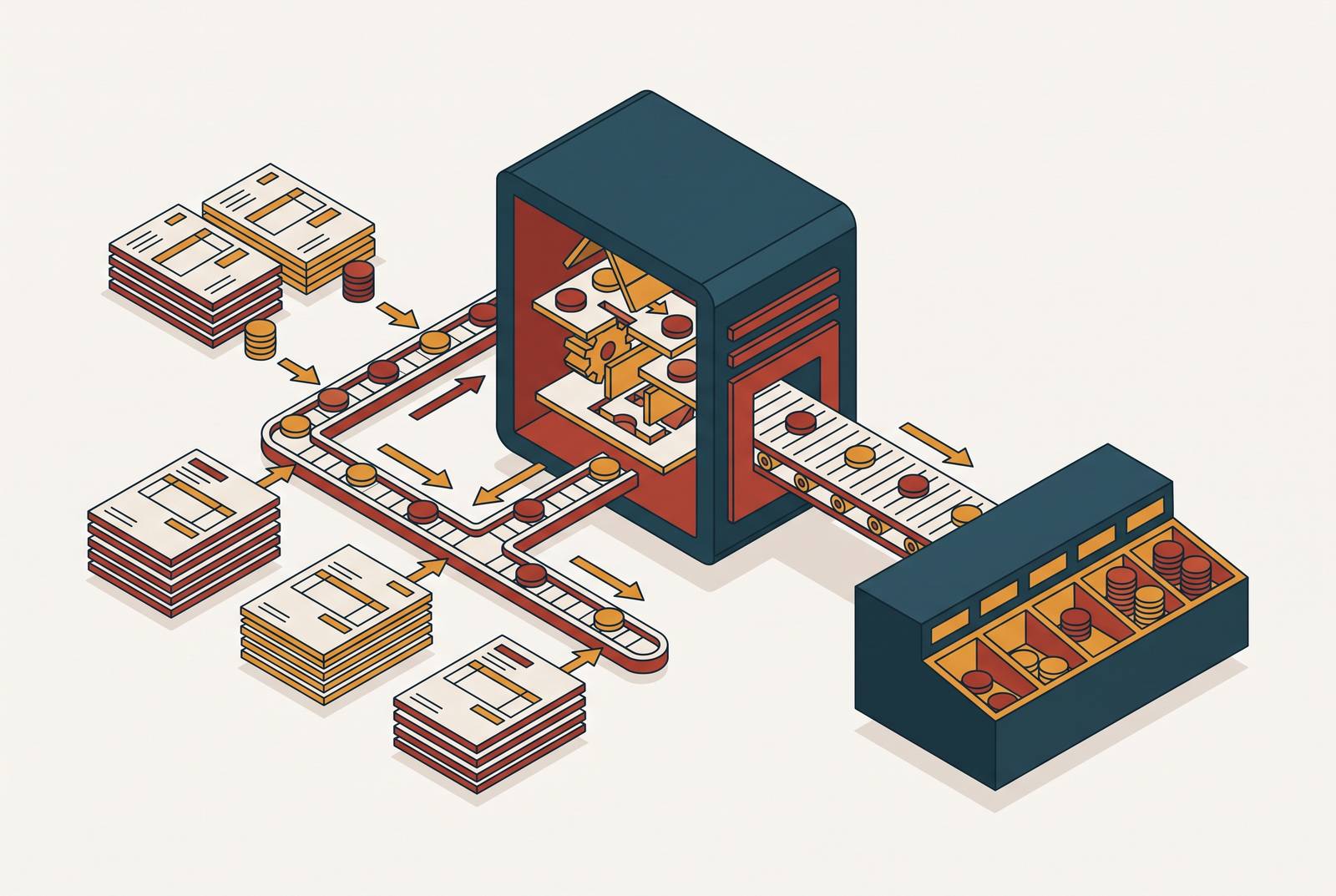
The payer adjudicates the claim and generates an ERA file in the X12 835 transaction format. That file gets sent to a clearinghouse or straight to the billing system, which matches it to the original claim using the claim number, patient identifiers, and dates of service. Once matched, paid amounts post to the claim record, and the CARCs and RARCs attach alongside them rather than getting stripped out. Contractual adjustments apply automatically, the patient responsibility balance gets calculated and queued for billing, and both the ERA-level and claim-level data write to an audit trail.
Patient-side posting works on a similar principle. When a patient pays through an online portal, automated tools tied into the practice management system post and reconcile that payment right away, cutting down on the kind of manual keying errors that creep into end-of-day reconciliation.
Robotic process automation, RPA, handles the routine matching and posting work. Layered on top, AI-driven tools take on the harder task of spotting patterns across whole batches of ERAs, not just single claims. None of this eliminates the need for oversight, though. Incorrect ERA-to-claim matches and misconfigured auto-posting rules are documented failure points. Automation moves the work faster; it doesn't make the work correct by default.
What CARCs and RARCs actually tell a practice, and why most systems ignore it
A CARC tells you the category of an adjustment: medical necessity, timely filing, missing prior authorization, bundling, the contracted rate itself, coordination of benefits. It's the difference between "denied" and an actual reason. A RARC adds the specificity underneath that reason, often naming the exact rule or coverage condition the payer applied. Together, they form a structured, machine-readable record of payer behavior on every claim submitted, about as close to a payer's internal audit trail as a provider ever gets to see.
Most practices don't use that record for much, and that failure deserves to be named directly. Manual posting treats a CARC as a field to key into the system, not a signal worth reading. Practice management systems often store the code but never surface it in any aggregate view, so a biller working one claim at a time has no way of noticing that a particular CARC has spiked across a payer or a procedure group over the past month.
Automated posting changes what's possible here. When CARCs get captured systematically instead of just recorded, patterns start to show. A payer might quietly shift how it adjudicates a specific procedure, a cluster of denials might be tied to a new medical-necessity algorithm, or a contract variance might show up again and again as a recurring underpayment. Kodiak Solutions VP Matt Szaflarski noted in early 2026 that payers are paying cleaner, simpler claims faster while, in his words, "the harder work is getting harder," pointing to clinical initial denials that keep climbing. That trend makes CARC-level pattern detection more valuable, not less, at exactly the moment fewer practices are set up to use it.
Underpayment detection: the revenue loss that posting data makes visible
An underpayment happens when a payer pays less than the contracted rate, and unlike a denial, it doesn't trip any workflow trigger in most systems. There's no red flag, no rejection code, nothing that routes the claim to a queue. It just sits there, paid, indistinguishable from a correct payment, until someone manually pulls the EOB and compares it against the fee schedule.
Automated posting closes that gap through contract variance detection. The system checks the amount actually posted against the contracted rate for that payer, procedure, and modifier the moment the ERA processes, not weeks later during a retrospective audit. Variances get flagged right away, while there's still time to dispute them, before the claim ages past a filing deadline and before the books close on the month.
That window isn't generous. After 60 days, the odds of full recovery drop sharply, and by 90 days claims start bumping up against payer timely filing limits, turning money the practice actually earned into a permanent write-off. Reworking denied claims carries meaningful administrative cost regardless of complexity. Underpayments that never get flagged skip that cost entirely, not because they're cheap to fix, but because nobody ever works them at all. The cheapest problem to solve turns out to be the one most systems never even see.
How denial patterns become visible at the moment of posting, not at month-end
In a manual workflow, denial trends usually surface from a report run at month-end, or worse, during a quarterly review. By then, the timely filing clock on the earliest denials in that batch may already have run out.
Automated posting attaches the denial reason, via the CARC, to the claim record the instant the ERA processes, which puts it in front of the denial management queue the same day. That changes what same-day triage actually looks like: a claim denied for a missing prior authorization can get corrected or appealed the day the ERA lands, not three weeks after the fact once someone finally opens the file.
Aggregate CARC data across a whole ERA batch does something a single claim review can't: it reveals spikes. If a payer suddenly starts generating a cluster of medical-necessity denials on a procedure that had been paying cleanly for months, that spike shows up in the posting run itself, not in an analytics report the following month. Payers are leaning harder into AI-driven medical-necessity review algorithms that flag claims with a precision providers haven't had to deal with before, a shift that is already stretching out AR timelines. A September 2025 survey of finance, billing, and claims management professionals, reported by Fierce Healthcare, found more than 41% of providers with denial rates above 10%. At that volume, a detection model that lags by even a few weeks means a real share of those denials age past the point of recovery before anyone even looks at them.
Where automated posting breaks down, and what monitoring has to cover
Automation fails loudest when it's configured wrong, because it fails at scale. A misconfigured auto-posting rule doesn't produce one bad posting, it produces the same bad posting on every claim that matches the rule, which makes it worse than a manual error precisely because it's systematic and repeats without anyone noticing.
ERA-to-claim mismatches are another known failure point. Duplicate claim numbers, split claims, and inconsistent payer formatting can cause a system to attach an ERA line to the wrong claim entirely. Fee schedules go stale too, and when they do, the system will happily mark a genuine underpayment as correct, quietly defeating the entire contract variance check described above. Zero-pay ERAs cause their own trouble: some payers send an ERA with a zero payment attached to a denial, and a system built only to post payments may route that file incorrectly or skip it outright. Patient responsibility calculations can go wrong too, particularly when secondary coverage or a pending coordination-of-benefits determination isn't accounted for before the balance posts.
None of this argues against automation. It argues that automated posting needs active rule maintenance, current fee schedules, and exception queues reviewed daily by billers who actually know how each payer formats its ERA data. Automation creates leverage, not autonomy, and practices that treat it as a set-it-and-forget-it system are the ones that end up with silent revenue leaks nobody notices for months. That mistake is buying the software and walking away from it. Research consistently shows that practices combining AI with active staff oversight achieve meaningfully better denial-rate reductions than those that deploy automation and leave it unmanaged.
The role of human expertise in making automated posting produce reliable intelligence
Automation is genuinely good at certain things: high-volume, rules-consistent matching and posting, capturing every CARC and RARC without fail, flagging variances against a fee schedule, and routing denials to a queue the second an ERA processes.
It's not good at recognizing when a payer has quietly changed its ERA formatting, or interpreting a CARC that the payer itself is misapplying, or knowing that a particular insurer changed its medical-necessity algorithm last month. That kind of knowledge, how a given payer formats its files, which RARCs that payer uses inconsistently, what actually fixes a recurring denial pattern with that specific insurer, doesn't live inside the ERA file. It builds up through time spent working that payer, claim after claim, appeal after appeal. When staff turn over, that knowledge leaves with them, which remains one of the structural weak points of in-house billing that no amount of automation resolves on its own.
The setup that actually holds up puts AI and RPA on the volume work and leaves in-house billing specialists working the exception queue automation surfaces: machine speed paired with human judgment on the claims that actually need it. Anyone pitching full automation with no staff oversight is selling something that falls apart under real payer behavior. The gap between adoption and results shows up clearly in the numbers: 63% of healthcare organizations already use AI or automation somewhere in the revenue cycle, yet only 15% report a positive return, according to HFMA and FinThrive research. That gap reflects something other than a failure of the technology. It's a failure of setup and oversight, and the practices skipping the oversight step are the ones showing up in that 85%.
How payment posting data connects to downstream revenue cycle decisions
The CARC captured at posting is the starting point for every appeal that follows. An incomplete or miscoded CARC means the appeal gets built on bad information from the start, no matter how good the appeal letter is.
Aggregate underpayment data, tracked over time from posting records, becomes the evidence base for a contract renegotiation. Without it, telling a payer their contracted rate is being systematically under-applied is just an assertion. With it, it's a documented case with dates and dollar amounts attached. Clean, timely posting also feeds directly into days-in-AR, since claims posted correctly and quickly move through the cycle, while claims that sit unposted or misposted age and drag the whole metric down. Industry guidance generally targets days in AR well below 50, with high performers achieving notably shorter cycles. Anything past 50 days is a warning sign, and past 60, real cash is stuck in claims nobody's working.
Clean claim rate benefits too. When posting data reveals a recurring denial reason tied to a front-end error, wrong eligibility information, a missing modifier, an incorrect place of service code, that intelligence can get pushed back upstream to stop the error before the claim ever goes out again. Industry benchmarks generally put a strong clean claim rate above 95%, with top performers doing better still. Patient billing accuracy depends on the same posting data, since the patient responsibility balance calculated at that stage feeds straight into statements and payment plans. Get that number wrong, and the patient gets billed wrong too, which slows collection and costs the practice trust it doesn't easily get back. Roughly half of all denials trace back to front-end errors, eligibility issues, demographic mistakes, insufficient authorizations, which means posting data that catches these patterns early carries a large share of the fix for denial volume overall.
What a well-functioning automated posting operation looks like in practice
ERA processing happens the same day the file arrives: payments, adjustments, and denials all posted together, not batched up for a weekly run. Every CARC and RARC gets stored at the claim line level and stays queryable, rather than getting flattened into a generic "denied" status that hides the reason underneath it.
Contract variance flagging runs continuously, and fee schedules stay current, so the system checks every posted payment against the contracted rate for that payer, procedure, and modifier before the transaction closes out. Exception queues exist, and someone actually works them daily, resolving mismatches, zero-pay ERAs, and variance flags before the claim has a chance to age. Denial reporting runs in real time instead of on a monthly cycle, so a spike in a specific denial reason shows up within days of appearing, not weeks later in a report nobody reads until it's due.
Patient responsibility balances get reviewed before statements go out. Automation does the calculating, but a person confirms it before a patient ever sees an incorrect bill. Secondary claims trigger automatically off the primary ERA, with coordination-of-benefits sequencing handled by the system rather than left to a biller's memory. EMR and clearinghouse integrations stay maintained, so the posting operation layers onto a practice's existing workflow instead of forcing a rebuild.
Pana Healthcare Solutions cited industry benchmarks in an October 2025 blog post pointing to organizations aiming to resolve 85% of denials within 30 days or less. That kind of target only holds up when the posting data underneath it is accurate, timely, and complete down to the CARC, from the moment the ERA first arrives.