AR Follow-Up Workflow for Denied and Unpaid Claims
Most denied claims never get appealed, costing practices millions in recoverable revenue.

Most denied and unpaid claims in a physician practice do not fail because the appeal would have lost. They fail because no one ever filed one. The single biggest driver of lost revenue in a typical revenue cycle is the absence of any disciplined follow-up once a denial lands, and the fix is operational. A practice that wants to cut its denial rate and recover what it is owed needs three things working together: a prioritized follow-up workflow built on claim age and dollar value, the KPIs to know whether that workflow is actually functioning, and either the staffing or the automation to run it on every claim, every day.
Why most denied and unpaid claims never get worked
The gap between what a practice bills and what it actually collects is rarely a function of how many claims get denied. It is a function of how many of those denials ever get worked again after the first rejection. Most denied claims are never reworked at all, and that resubmission gap, not the denial itself, is the single most consequential failure in a typical practice's revenue cycle.
The loss is cumulative, and it happens quietly. Claims sit untouched until they age past timely filing deadlines. Denials go uncontested because no one is assigned to contest them. Balances write off because nobody made any decision about them. Once accounts receivable ages past a critical threshold, the odds of full payment drop sharply, and that decline has little to do with whether the original denial reason was strong or weak. The delay itself becomes the enemy, independent of the underlying clinical or coding issue.
The practical conclusion follows directly: practices are not losing this money because their appeals would fail. They are losing it because the appeal process never starts. That distinction matters because it changes where the fix belongs. A practice does not need better arguments for payers. It needs a workflow that guarantees every denied dollar gets looked at by a human or a system before the filing window closes.
How payer behavior exploits practices that skip follow-up
Payers build their claims processes around an assumption that most practices will not push back. The pattern sometimes called "delay, deny, defend" works specifically because providers accept denials as final rather than treating them as the opening move in a negotiation. Slow processing, technical denial reasons, and repeated demands to re-prove medical necessity only cost a payer money when a provider actually contests them.
Denial rates among ACA marketplace insurers show how unevenly that pressure gets applied. CMS data shows Oscar Health denies more than one in four marketplace claims, Molina Healthcare crosses the one-in-five mark, but Kaiser Permanente's denial rate sat near one in seventeen. That spread between insurers operating in the same regulatory market shows denial rates are a product of individual payer policy and practice, not some fixed cost of doing business with insurance.
Prior authorization adds a second, compounding layer of friction on top of standard claims denials. A KFF analysis of CMS-required prior authorization disclosures for 2025 found health insurers denying a substantial share of standard prior authorization requests across Medicare Advantage, Medicaid managed care, and ACA marketplace plans, with UnitedHealth Group and Centene among the highest-denying insurers in their respective markets.
The overturn numbers are where the pattern becomes hardest to defend. KFF found that a majority of Medicare Advantage prior authorization denials got overturned on appeal, and Centene's Medicare Advantage overturn rate came in extraordinarily high, specifically, denials were overturned on appeal more than 90% of the time, against a market average of 67%. When that many initial denials collapse under appeal, the appeal was always winnable. The practice that never filed it simply handed the payer money it was never entitled to keep.
None of this is fixed in stone. CMS data shows Blue Cross Blue Shield of Montana and UnitedHealthcare each cutting their denial rates significantly in a single year. Denial rates move when payers face scrutiny, public reporting, and sustained pushback, so a practice's own persistence is one of the few variables it actually controls.
What a functioning AR follow-up workflow looks like
You don't need complicated technology or an oversized billing staff to run an effective AR follow-up process. It requires prioritization rules that most practices talk about but never actually write down and enforce.
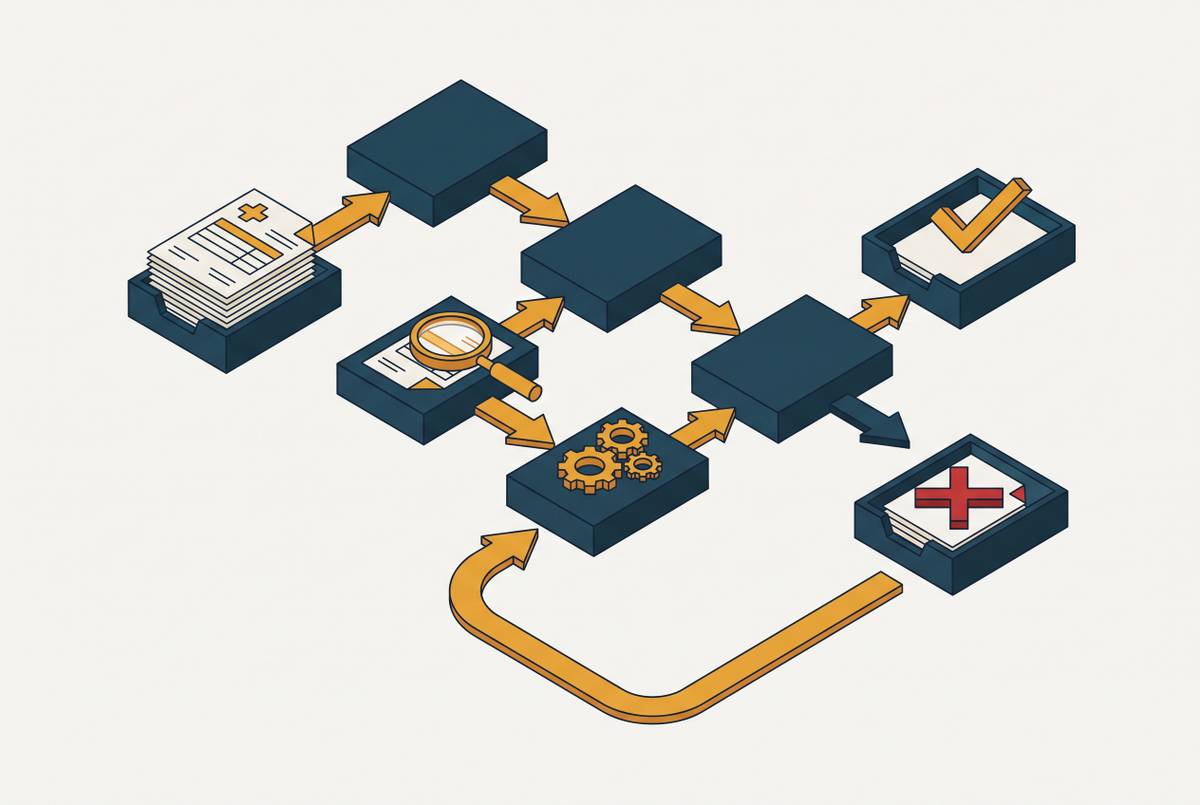
The backbone of that system is the aging bucket. Every claim's follow-up action should be dictated by how long it has sat unpaid, not by which staff member happens to notice it first. In the earliest bucket, the job is simple: confirm the claim was received, through the clearinghouse or the payer portal, and watch for status changes. As a claim moves into the middle range, follow-up shifts to active portal checks, confirming the payer isn't sitting on a request for additional documentation. Once a claim pushes into the later bucket, portal checks stop being sufficient and direct contact with the payer becomes necessary, with escalation triggered if there's no movement. In the final bucket, escalation has to turn immediate, and appeal preparation starts without delay. Past 120 days, a claim needs either a final appeal or a referral to collections, because this is the point where the risk of permanent, uncollectible loss is highest.
Within each of those buckets, dollar value sets the order of work. A high-value claim sitting in an earlier bucket should get attention before a low-value claim sitting in a later one, because the recovery math on a five-figure surgical claim outweighs a handful of smaller claims that happen to be older.
Before any claim gets resubmitted, the root cause of the denial has to be identified. The specific denial reason code determines the fix: a documentation correction, a coding adjustment, an attached authorization, or an eligibility clarification. Guessing at the fix wastes the one attempt a practice often has left before timely filing closes the door.
Corrected claims follow a specific, defined protocol: the claim gets corrected inside the practice management system and resubmitted through the clearinghouse using claim frequency code 7 for a corrected claim or code 8 for a void and replace, with the correction documented in the claim notes, including the correction date, the specific fields changed, and the name of the analyst who made the change. That paper trail matters when a payer disputes the resubmission later.
Appeals built on medical necessity denials need a structured packet, not a simple resubmission. That packet includes the clinical documentation supporting the service, references to the specific payer policy at issue, and a concise appeal letter tying the two together.
One case illustrates what's at stake when this workflow runs as designed: a high-value surgery claim, denied for missing documentation and otherwise destined to be written off, got recovered in full within weeks once a structured appeal packet was assembled and escalated to a payer supervisor. That recovery happened because a workflow triggered the follow-up. Timely filing deadlines are hard stops. Once a claim ages past a payer's filing window, no documentation, however complete, brings that money back. That is why the aging bucket system exists: to make sure no claim reaches that deadline without someone having acted on it.
The metrics that reveal whether a practice's AR follow-up is working
Tracking the right numbers is what lets a practice tell actual collections apart from revenue it is slowly writing off. Measurement is how a practice finds the money it does not know it is losing, because a denial that never gets flagged in a report is a denial nobody will ever appeal.
Four metrics define whether AR follow-up is functioning. Days in AR measures how long claims sit unpaid on average, with a best-practice benchmark under 35 days; claims that drift into the later aging buckets carry compounding collection risk the longer they stay there. Denial rate measures what share of submitted claims get rejected outright, and best practice keeps it under 5%; if the rate climbs into double digits, both denial prevention and follow-up are breaking down at once. First-pass resolution rate measures what share of claims get paid on the first submission, with best practice well above the industry norm; a low rate means claims are reaching payers carrying preventable errors that trigger denials before any follow-up process even gets a chance to work.
Those benchmarks are not abstract targets. Experian Health's State of Claims 2025 survey found more than four in ten healthcare providers now see elevated denial rates, a trend that has risen every survey year since 2022. AR days have climbed industry-wide too, driven in large part by prior authorization backlogs, so practices need to build escalation triggers around payer-caused delay, not only around their own internal processing speed.
The space between where these benchmarks sit and where most practices actually operate isn't random variation. It tracks directly to whether a formal, written follow-up workflow exists in that practice or not.
Where AR follow-up workflows break down in practice
Most AR follow-up failures trace back to the same handful of structural gaps, not to any individual biller's mistakes or lack of effort.
The most basic gap is the absence of a formal prioritization system. Without explicit aging bucket rules and dollar-value sequencing, claims get worked opportunistically, by whoever happens to open them first, rather than by which claim carries the highest risk of permanent loss.
Denial intelligence often sits in silos. Reason codes get logged in the system but never analyzed for patterns, so the same preventable errors recur claim after claim, and payer-specific quirks go unnoticed until someone reviews the books at month-end, long after the pattern started.
Staff turnover erases institutional memory fast. Knowledge of how a specific payer actually behaves (what documentation it demands, which escalation path gets a denial reversed, what language moves an appeal forward) tends to live inside individual billers' heads. When that biller leaves, the practice starts relearning those lessons from scratch.
Visibility tends to lag, arriving only in periodic snapshots. Month-end AR reviews run on information that is already 30 days stale, so by the time a 90-day claim appears on a report, the window to escalate it may already be nearly shut.
Manual status-checking eats time that should go toward higher-value work. Hours spent on payer portal checks and phone hold queues are hours not spent building appeals or escalating stalled claims, and the sheer volume of routine monitoring crowds out the recovery work that actually brings money in.
Payer policy also changes without warning. A rule shift mid-cycle can trigger a spike in denials well before a billing team even realizes the underlying policy moved, so what looks like a wave of billing errors is often a payer-side change the practice has not yet caught up to.
How automation and AI address AR follow-up's structural gaps
Automation's real value in AR follow-up is making sure no claim gets missed and that every denial actually reaches a person equipped to act on it.
Electronic remittance advice auto-posting removes the manual bottleneck of posting payments by hand, which frees up biller time for the work that actually recovers money: working denials. AI-driven denial prediction flags claims likely to be rejected before they're even submitted, which lets a practice fix the problem at the source instead of discovering it weeks later in a denial letter, turning the workflow from reactive to preventive. Real-time AR dashboards replace the month-end review entirely, surfacing aging claims and denial spikes the moment they appear rather than weeks after the recovery window has already narrowed. Payer-specific rule engines encode how a given insurer adjudicates claims, catching the specific edits one payer is likely to reject before that claim ever leaves the practice.
Where automation gets layered onto a practice matters as much as what it does. Automation that forces a practice to abandon its existing EMR or retrain its front desk introduces friction that cancels out whatever revenue it recovers. The automation that actually works connects into the systems a practice already runs. An AI-powered medical billing service like Altair Health manages the full denial-to-appeal workflow systematically, because most practices simply lack the staffing to work every denial the day it arrives, even though that is what the recovery math demands.
The strongest case against fully autonomous AR systems is that they handle volume well but miss the cases that need a human mind: a denial that hinges on a clinical argument, a payer escalation that depends on knowing exactly who to call, an appeal that requires reading a policy against the specific details of a patient's record. Those situations call for a person with payer-specific expertise, not more automated processing. The practices recovering revenue fastest are the ones with real-time visibility into why claims keep bouncing and which payer behaviors drive which denial patterns, institutional knowledge that compounds over time and usually evaporates the moment a billing staffer leaves. Services that pair AI pattern recognition with in-house expert billers preserve that memory and keep every denial moving while the recovery window is still open.
Experian Health's data shows 63% of providers have introduced AI into their workflows in some form, but only 15% have fully integrated it into standard revenue cycle operations. That gap between adopting a tool and actually running the revenue cycle through it is where most of the unrealized opportunity sits, and a model combining automation with in-house billing specialists for exception handling tends to outperform either approach running alone.
CMS's 2026 prior authorization rule changes and AR follow-up timelines
The regulatory environment around prior authorization shifted in a way that directly favors practices willing to hold payers to firmer standards. The CMS Interoperability and Prior Authorization Final Rule, designated CMS-0057-F, took operational effect on January 1, 2026, and it changes the timing math behind AR follow-up by putting enforceable response deadlines on payers for the first time.
The rule carries three mandates that matter directly to how practices should structure follow-up. Standard prior authorization decisions now have to come back within a defined window, replacing the previously open-ended processing times that let payers slow-walk requests without consequence. Covered payers must also publicly report prior authorization metrics, including denial rates, processing times, and appeal overturn rates, with the first reports covering 2025 due by March 31, 2026, the same data set behind the KFF analysis cited earlier in this piece. That transparency requirement hands practices documented, payer-specific evidence of denial and overturn patterns they can cite directly when building appeals and deciding where to escalate.
A disciplined AR follow-up process depends on exactly this kind of explicit prioritization paired with real-time visibility into claim status, integrated directly into the EMR and clearinghouse systems a practice already runs, so staff can follow a structured aging and dollar-value hierarchy without tearing out their existing tools or retraining the front desk. With payers now required to publish their own numbers on denials and overturns, practices have, for the first time, a documented basis for arguing that a given denial fits a pattern the payer's own reporting already admits to.