Clinical Denial Definition and Appeal Strategy for Physician Practices
Tailor clinical denial appeals to the specific denial type for better recovery rates.

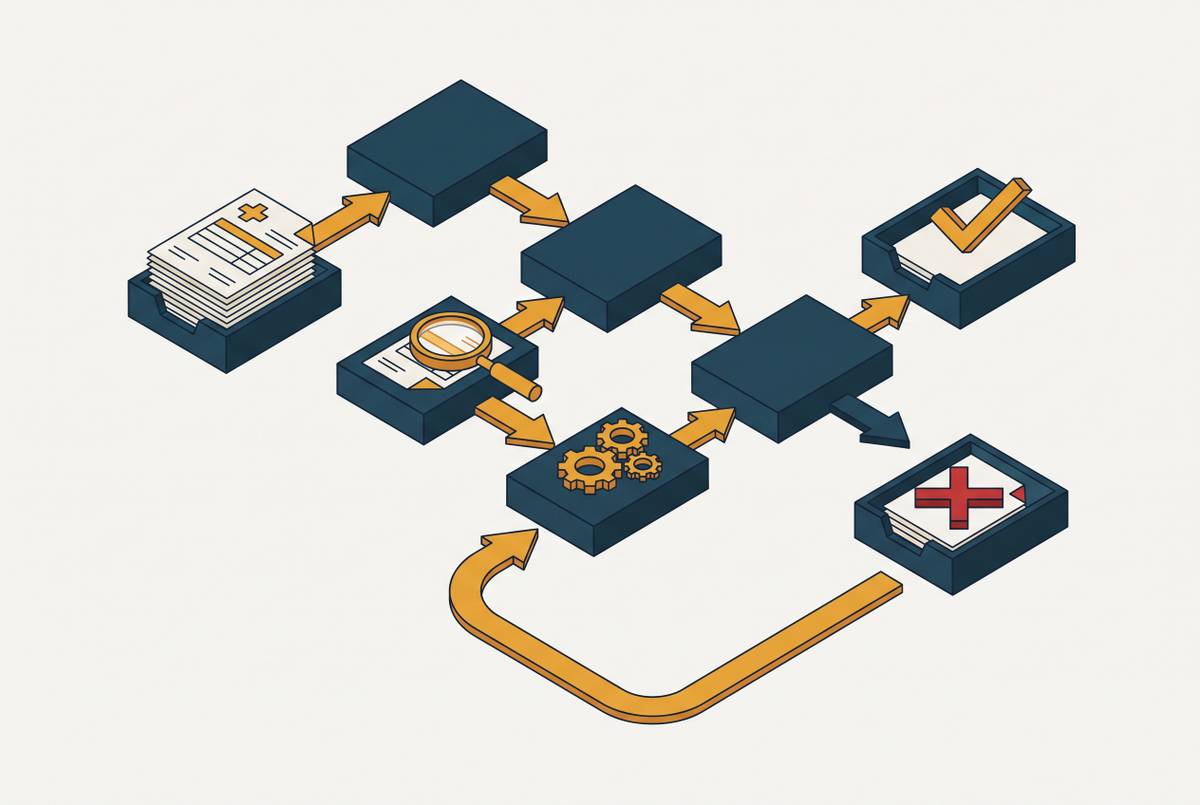
Clinical denials aren't one problem wearing different masks. Medical necessity denials, level-of-care downgrades, and authorization failures each fail for a distinct reason, and each demands its own appeal logic rather than a shared template. Physician practices that build separate response paths for each type recover meaningfully more denied revenue than those running every denial through the same generic workflow.
Why clinical denials demand a distinct response
A denial splits into two very different buckets, and most practices don't treat the split accordingly. Administrative denials come from wrong or missing information, duplicate claims, or blown timely-filing deadlines. Fix the error, resubmit, done. Clinical denials are a different animal entirely: the payer isn't quibbling over a typo or a missing modifier, it's disputing whether the care should have happened at all, at that level, or under that authorization. That kind of dispute doesn't get resolved with a corrected form. It needs an evidence-based rebuttal that speaks to the specific clinical standard the payer applied.
The stakes compound quickly when that rebuttal is late. A clinical denial left unanswered doesn't sit still, it converts to a hard denial and, eventually, a permanent write-off. Change Healthcare's Revenue Cycle Denials Index puts total annual claims denials at $262 billion nationally, and even a practice-sized slice of that number is recoverable revenue sitting in limbo rather than money that's actually gone Change Healthcare Revenue Cycle Denials Index. A 2025 Experian Health survey of 250 revenue cycle leaders, fielded that June and July, found 41% of providers now report more than 10% of claims denied, up from 30% in 2022, a system getting worse rather than stabilizing Experian State of Claims Report 2025 Experian Health's 2025 State of Claims survey. That's a system getting worse rather than stabilizing. That's a system getting worse, not stabilizing.
None of this means practices need to work harder on appeals. It means matching the response to the denial actually received, instead of running every clinical denial through the same one-size-fits-all letter.
The four clinical denial types and what each one is really saying
Four categories cover most of the clinical denial universe, and each one is arguing something different Medical Billers and Coders. A medical necessity denial means the payer decided the service itself wasn't clinically required under its own criteria, full stop. A level-of-care denial concedes the service happened but argues it should've happened somewhere cheaper, outpatient instead of inpatient, observation instead of admission. That's a status argument, not a service argument, and conflating the two is where a lot of appeals go sideways before they're even written.
An authorization denial involves services rendered without prior approval, or with approval that doesn't quite match what was billed. It's the most preventable of the four, but it runs on a completely different appeal logic than a necessity dispute, because it's fundamentally a paperwork-and-policy argument rather than a clinical-evidence one Medical Billers and Coders.
Treating these four as interchangeable, sending the same appeal letter regardless of which one landed, is exactly where recoverable revenue gets lost before a single word gets written Medical Billers and Coders. And on the level-of-care side in particular, a soft clinical denial (payer withholding pending more documentation) has a short window before it hardens. Missing that window on a status dispute is a specifically expensive mistake, because status disputes rarely get easier to argue after the fact.
Payer behavior driving clinical denial volume upward in 2025 and 2026
The industry-wide initial denial rate climbed from 10.2% in 2020 to 11.8% in 2024, with commercial payers running anywhere from 10% to 16% depending on which one you're billing, Experian's State of Claims Report shows Experian State of Claims Report 2025. A technology shift is changing the speed and character of adjudication itself, and it is producing that climb. AI-assisted review has cut decision turnaround from the old 3-to-5-business-day human review cycle down to hours in many cases, but 60% of physicians surveyed in the AMA's 2025 Prior Authorization Survey said they're worried AI is increasing denial rates, not just processing them faster. Faster decisions paired with a higher denial rate is an accuracy problem dressed up as an efficiency gain. It's an accuracy problem dressed up as an efficiency gain, and it generates more appeals work, not less.
Payers are also changing their own rules mid-stream without telling anyone. UnitedHealthcare updated its bundling edit library in the third quarter of 2025, adding 847 new code pairs to its unbundling detection list, and practices billing correctly under the prior edit set began generating CARC 4 denials on previously clean claims Medical Billers and Coders. UHC also tightened its internal medical necessity criteria for Behavioral Health Integration services in 2025, applying a standard stricter than CMS guidance for traditional Medicare. Practices that didn't update their prior authorization checklists to match that shift are now generating authorization denials on services they've ordered routinely for years, because the payer's requirement moved underneath the service.
The dollar figures back up how much harder this has gotten to manage. Enjoin CDI puts net revenue leakage at $38.6 billion in 2024, rising to $48.4 billion in 2025, a 25% jump in a single year Crowe RCA Benchmarking. That growth outpaces denial volume alone, which points to resolution complexity itself getting more expensive, not just more frequent Crowe RCA Benchmarking Enjoin CDI. None of this traces back to practices documenting worse. It traces back to payer-side algorithms and policy criteria moving. The appeal strategy has to track what changed on the payer's end, not just tighten internal documentation habits.
Medical necessity appeals: what the payer's reviewer is evaluating
A medical necessity appeal has to speak directly to the payer's own stated criteria. Most commercial payers and Medicare Advantage plans lean on either InterQual or MCG Health criteria as their benchmark. Knowing which one a given payer uses is the starting point for writing anything that will actually land.
The structure that works follows a predictable shape: state the denial reason and request reconsideration up front, summarize the clinical background and course of care, rebut with objective evidence tied to the payer's own guideline language, then restate the request and attach supporting documentation. What actually moves a reviewer is the admitting diagnosis, the severity of illness, the clinical complexity that required the level of monitoring given, and any complications or comorbidities that shaped the course of treatment. Progress notes, nursing documentation, diagnostic results, and physician orders all carry weight here, and the appeal's job is to connect the patient's actual presentation to the specific coverage threshold in the exact language a reviewer is trained to evaluate.
Bringing in a physician advisor changes how the appeal reads on the other end, too. A peer-level voice gets a different response from medical directors than a purely administrative appeal does, and that distinction matters most on high-cost procedures where payers apply extra scrutiny. The letters that fail usually connect the clinical facts to the wrong criteria or fail to link them to the specific coverage threshold in language the reviewer can actually act on. They fail because they don't cite the right criteria or connect the clinical facts to the specific coverage threshold in language the reviewer can actually act on. MBC's 2026 denial analysis shows UHC-specific appeals that invoke CMS's 2024 Final Rule (which requires MA plans to use Medicare-consistent criteria) to challenge UHC's more restrictive BHI medical necessity criteria succeed at a 64% rate on first-level appeal, significantly higher than generic medical necessity appeals.
Level-of-care appeals: defending inpatient status against observation downgrades
A level-of-care denial isn't arguing the care shouldn't have happened, it's arguing it happened in the wrong place. The payer accepts the service, it just thinks a cheaper setting would've done the job. That framing changes what the appeal needs to prove: why outpatient care was inappropriate, what adverse-outcome risk existed, what comorbidity complexity was in play, and what lower-level interventions had already been tried and failed.
This is where clinical documentation integrity work upstream pays off downstream. When CDI specialists are engaged during the encounter itself, clarifying diagnoses, capturing severity of illness, making sure the record reflects the actual complexity of care given, the appeal team has a record that already demonstrates medical necessity through clear clinical indicators rather than one that has to be reconstructed after the fact. AGS Health also points to utilization review nurses embedded directly in the emergency department as a best practice, since getting the status assignment right at admission makes the appeal, if one's even needed, dramatically easier.
Recurring denials on the same observation-versus-inpatient question aren't just a documentation problem repeating itself. They usually signal a systemic gap in the UR protocol. Appeal outcomes need to feed back into admission workflows, not just get filed and closed. BCBS medical necessity denials that run through AIM Specialty Health require peer-to-peer review as the first appeal step, not a written appeal, and a practice that files written first on one of these can fail on procedural grounds before anyone even looks at the clinical argument. A practice losing the same level-of-care argument repeatedly on one service line is carrying a systemic revenue gap that compounds across every admission in that category, not just eating individual claim losses. It's carrying a systemic revenue gap that compounds across every admission in that category.
Authorization denials: the appeal structure when a process failure meets a clinical decision
No authorization obtained at all means arguing the service was self-evidently necessary or genuinely emergent, which is a harder case with a lower ceiling for success. Authorization obtained but mismatched, wrong date, wrong place of service, wrong provider NPI, means documenting the exact mismatch and pointing back to the authorization that was actually in place when the service happened. And authorization obtained correctly under the rules that existed at the time, but denied now because the payer's requirement quietly changed, means the appeal has to establish what policy was actually in effect at the moment the service was ordered.
Timing is unforgiving here. UHC's peer-to-peer window for authorization-related denials runs 3 business days for inpatient cases or 21 calendar days for outpatient cases, counted from the posted denial date, and missing either window turns a recoverable claim into a permanent write-off. BCBS state plan windows run longer, generally in the 30-to-60-day range. The 2025 Experian survey found 35% of providers naming authorizations as a major denial trigger, which makes this category a real volume driver even though it's the one most within a practice's own control to prevent Provider Survey. The underlying logic to remember: an authorization appeal isn't primarily a clinical argument at all, it's a policy-and-process argument about what authorization existed, when, and under what rule.
Speed matters more here than it used to, and AI adjudication is a big part of why AMA's 2025 Prior Authorization Survey. The AMA's 2025 Prior Authorization Survey found denial rates from AI-assisted review running 40% higher than human-reviewed decisions, meaning authorization denials are showing up faster and in greater volume than they did even a couple of years back.
Payer-specific appeal mechanics that override generic workflows
Any denial workflow built to work identically across every payer will underperform on at least one major payer at all times, because UHC and BCBS simply don't adjudicate the same way. Their CARC code usage and appeal requirements diverge structurally, a pattern confirmed across roughly 240 specialty practices in MBC's analysis. The CARC code split is the first trap practices walk into Medical Billers and Coders. UHC uses CARC 4, procedure inconsistent with modifier, for modifier bundling disputes. BCBS codes the identical dispute as CARC 97, payment adjusted, contractual obligation. The documentation each payer expects in response is different, and an appeal written for UHC's CARC 4 process, submitted against a BCBS CARC 97 denial, fails on procedural grounds before the clinical merits ever come into play.
UHC's modifier bundling appeals specifically need two things: clinical documentation showing the procedures were genuinely distinct and separately reportable, and a citation to the CMS NCCI edit table confirming no NCCI edit exists for that code pair, or a direct challenge to the proprietary edit's clinical basis through UHC's provider dispute resolution process. A generic appeal that just says the procedures were separately performed fails at a high rate. One that cites the specific NCCI table and points out the conflict with UHC's edit succeeds far more often. On the BCBS side, medical necessity denials routed through AIM Specialty Health need peer-to-peer review first, not a written appeal, and skipping straight to written correspondence burns the appeal window for nothing.
Deadlines carry the same payer-specific logic, and missing one is permanent. UHC's peer-to-peer window and BCBS's state plan windows differ enough that applying one payer's timeline to the other's denial converts a winnable claim into a write-off. And because payers update their adjudication systems on their own schedule, UHC's 847-new-code-pair bundling update in the third quarter of 2025 being one concrete example, an appeal template built even six months ago may no longer speak to the current version of the denial trigger it was written for Medical Billers and Coders. Templates need to map to specific CARC codes per payer and get revisited every time a payer changes its system Medical Billers and Coders. A static template library isn't neutral infrastructure sitting quietly in the background, it's a liability accumulating quietly until it fails on a claim that mattered.
CDI, utilization review, and appeals data connecting to prevent the next denial
Appeal outcomes aren't just wins or losses to log and move past. They're diagnostic information. When the same documentation pattern, the same payer, or the same service line keeps generating denials, that's an upstream workflow gap showing itself repeatedly. The fix depends entirely on which pattern is repeating, and each denial type points somewhere different.
Recurring level-of-care denials call for stronger UR protocols and earlier physician advisor involvement at the point of admission, before the status decision hardens into something an appeal has to fight later. Recurring documentation-driven necessity denials call for CDI education and real-time query support built into the encounter itself, rather than reconstruction after discharge. And recurring authorization denials call for updating PA checklists the moment a payer changes its requirements, not after the first denial has already landed and the claim is already sitting in appeal. Each of these loops closes the same way: the appeal isn't just recovering one claim, it's telling the practice exactly where its own process needs to change before the next one arrives.