Denial Management Process Flowchart for Physician Practices
Denial rates hit 12 percent as payers tighten review processes.
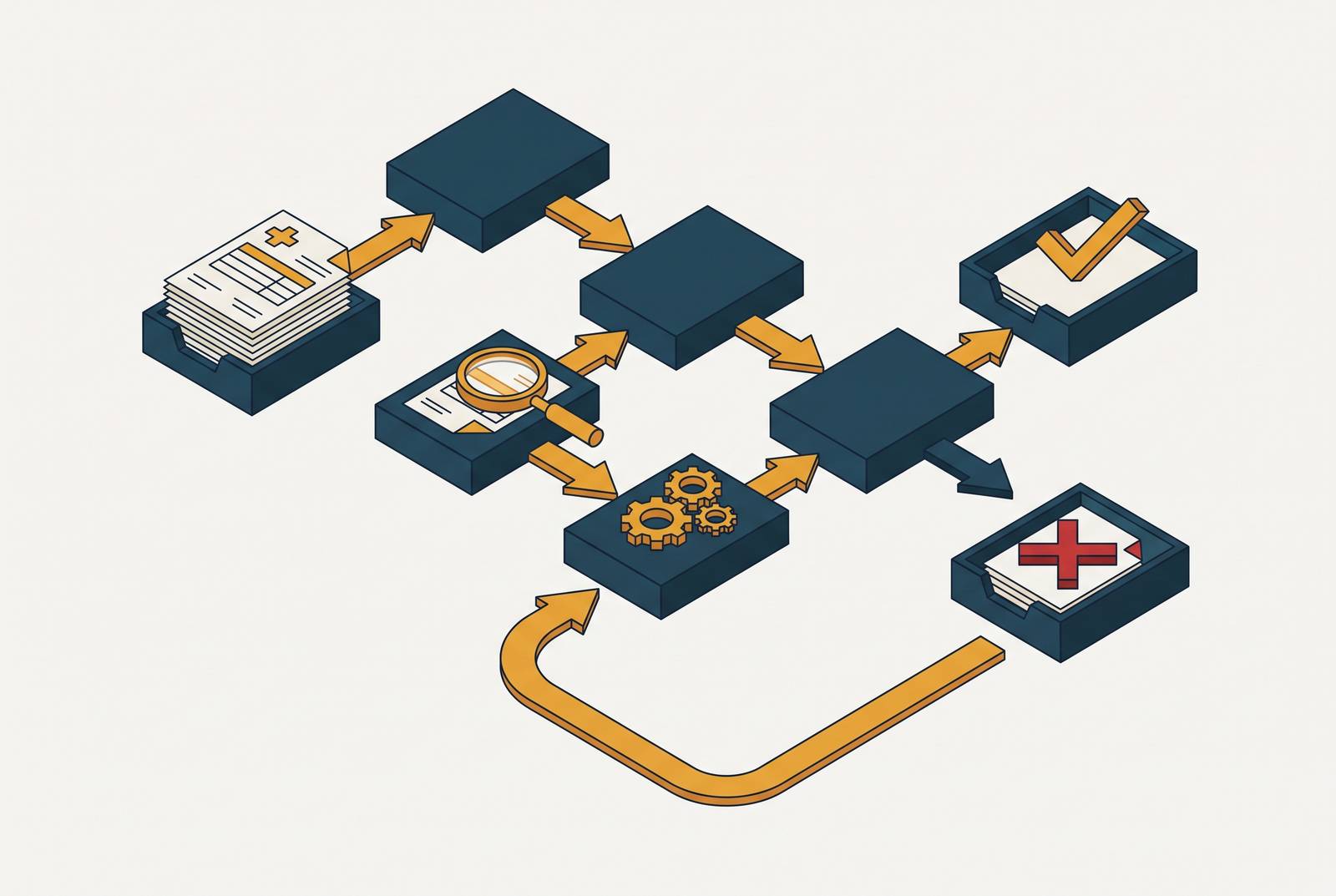
Physician practices lost roughly a quarter more net revenue to payer denials in 2025 than the year before. That figure comes from a review covering more than 2,300 hospitals and 350,000 physicians' revenue cycle data, and it's the clearest sign yet that denial management has stopped being a back-office housekeeping task and become a front-line financial defense. Denial rates averaged close to 12% across the industry in 2025, and per an Experian Health survey of 250 healthcare professionals cited in Physicians Practice, 41% of providers now report denial rates above 10%, up from just 30% three years ago. An industry benchmarking body sets the acceptable benchmark at 5%. The gap between that number and where most practices actually sit is not a rounding error. Payers' rebuilt adjudication processes raise it, and it appears on the bottom line every single month.
Between 2022 and 2023, an average of 14% of commercial claims, 16% of Medicare Advantage claims, and 20% of ACA Marketplace claims were denied on first submission, increases as steep as 25% over the prior eight years. None of this is random noise in the system. It's the predictable result of how payers have rebuilt their adjudication processes, and any practice that wants to stop the bleeding needs to understand what changed before it can build a workflow that fixes it.
What payers are doing to generate denials, and why the environment is harder in 2026
Payers now run algorithm-driven review systems that don't just check whether a code was submitted correctly. They check whether the clinical story behind the claim actually supports what got billed. A documentation gap that a human reviewer might have let slide five years ago, a missing sentence linking symptom to diagnosis to treatment, now trips an automatic rejection before anyone on the payer side even looks at the file. Payer audits climbed 30% year over year across the first three quarters of 2025, and the average denied outpatient hospital claim now runs over $5,300.
Medicare Advantage sits at the center of this shift, and the numbers there deserve their own paragraph. KFF reported that MA insurers issued close to 53 million prior authorization determinations in 2024. MA denial rates jumped 4.8% year over year, the sharpest increase of any payer category, and now sit above 17%, more than double the rate under traditional Medicare. The average denied amount tied to an MA claim rose 22.4% to roughly $1,000 between 2024 and 2025. KFF's analysis also found MA plans required prior authorization for more than 4,000 distinct services in 2024, and that list keeps growing rather than shrinking.
Add to this the disruption from MA plan exits in certain markets. Practices operating where an MA plan pulled out are seeing denial spikes of 20 to 30% above baseline, driven by authorization gaps as patients get shuffled between plans mid-transition. This has hit hardest in early 2026, right as many of those transitions took effect.
None of this happens by accident. Payers operate on the well-worn assumption that most practices won't push back: delay the payment, deny the claim, defend the denial if challenged, and bank the fact that most providers give up before they file an appeal. A denial workflow built without that assumption in mind is a workflow that's already lost the fight before it started.
How the denial management flowchart is structured: the six stages
A denial management flowchart that actually functions runs through six sequential stages. Each one has a clear trigger that starts it, a set of decisions that have to get made inside it, and a defined condition that has to be met before a claim can move to the next stage. No denial should skip ahead, and none should sit in limbo between stages waiting for someone to notice it.
The six stages, in order: denial identification, where the denial gets caught and logged the moment it arrives; categorization, where it gets sorted so the right workflow fires; root cause analysis, where the practice traces the error back to its actual origin; correction and resubmission, where the specific mistake gets fixed and refiled inside the deadline; appeals, for the cases where resubmission isn't the right tool; and trend analysis and prevention, where the accumulated denial data gets fed back upstream to stop the same error from repeating.
None of this works without a centralized tracking system logging the denial date, denial code, payer name, claim amount, and service date for every single denied claim. Skipping that step turns stages three and six into guesswork. There's no root cause analysis without a record of what happened, and there's no trend analysis without a body of records to draw a trend from.
This flowchart isn't a straight line for every claim that enters it. Categorization in Stage 2 splits denials onto different correction paths depending on what kind of error caused them. Appeals in Stage 5 are a branch off that trunk. Treating every denial as though it needs the same five-step march wastes staff time on cases that could be fixed with one phone call and one resubmission.
Stage 1 and 2: Catching the denial the moment it lands and routing it to the right queue
Denial identification starts the moment a payer response comes back, through remittance advice, a payer portal, an explanation of benefits, or an electronic claim response. The first real decision a practice has to make here is simple but gets missed constantly: is this a denial, or a rejection? A rejection means the claim never made it into adjudication at all, usually because of a formatting or eligibility problem caught at the front door. A denial means the claim went all the way through review and came back unpaid. These need different handling, and treating them as the same thing wastes time chasing the wrong fix.
Every denial has to get logged into the tracking system right away: denial date, denial code, payer, claim amount, service date, patient identifier. Automation can flag a denial the second it lands, but the entry still needs a person to confirm it's complete and accurate. That system is only as good as the discipline behind the data entry.
Manual tracking is where things fall apart. Manual tracking is exactly where denials sit unworked until the resubmission window quietly closes.
Categorization comes next, and it sorts denials into three buckets. Administrative denials cover missing information, authorization problems, and eligibility mismatches. Clinical denials involve medical necessity determinations and documentation gaps. Technical rejections cover electronic submission errors and formatting mistakes. This sorting isn't paperwork for its own sake, it decides which correction workflow gets triggered next, and getting the category wrong means wasted effort on the wrong fix.
Sorting denials by insurance class and denial code surfaces patterns that a practice can act on. If one payer or one recurring error accounts for a disproportionate share of the pile, that's actionable information. Given that MA claims carry a 17% denial rate and denied claim values there jumped 22.4%, MA denials deserve their own sub-queue with payer-specific handling rather than getting lumped in with everything else. The output of Stage 2 should be a routed, prioritized worklist.
What separates practices that recover denied revenue from practices that don't comes down almost entirely to how well Stages 1 and 2 get executed. A denial that sits unlogged and uncategorized keeps aging, and once it passes the resubmission or appeal deadline, that revenue is gone for good.
Stage 3: Tracing the denial back to where the process broke
Root cause analysis asks a different question than most people expect. It's not about what the payer rejected on paper, it's about where in the practice's own process the mistake actually started. Root cause analysis asks a different question than most people expect: it's not about what the payer rejected on paper, it's about where in the practice's own process the mistake actually started, and getting that answer right prevents the next hundred claims like it, not just the one in front of you.
Six points in the process tend to be where things go wrong. Patient registration introduces demographic errors, coverage mismatches, or eligibility that never got verified before the visit happened. Insurance verification can confirm coverage exists while missing whether benefits actually apply, or missing a secondary payer. Prior authorization breaks down when the auth was never obtained, expired before the service was rendered, or the approval number never made it onto the claim. Physician documentation fails when the note doesn't support the level of service billed, or when the connection between diagnosis and treatment never gets spelled out in plain language. Charge entry introduces wrong codes, missing or incorrect modifiers, and bundling mistakes. Claim submission fails when a claim goes out after the timely filing deadline, to the wrong payer ID, or in the wrong format.
Eligibility and registration errors are consistently among the leading drivers of denials. If root cause analysis keeps landing on registration, the fix isn't a billing department problem, it's a front-desk problem, and no amount of coding cleanup downstream will solve it.
The rise of algorithm-driven adjudication changes what root cause even means for documentation failures. Documentation gaps that once prompted a request for additional information now increasingly result in outright denials, as algorithm-driven review finds the clinical narrative insufficient to support the billed service. In those cases, the root cause sits in the physician's note.
Stage 4: Correcting the specific error and resubmitting before the deadline closes
Correction has to match the root cause identified in Stage 3. A demographic or eligibility error means updating the patient's information, re-verifying coverage, and resubmitting the corrected claim. A missing or expired authorization means pursuing a retroactive auth where the payer allows it and attaching the approval number before resubmitting; where retroactive auth isn't an option, the claim should route straight to appeal instead of wasting a resubmission cycle.
Documentation insufficiency calls for going back to the provider for an updated note, one that ties diagnosis, symptoms, and treatment plan together in language that holds up under review. Payers are increasingly expecting that narrative structure spelled out rather than implied. A coding error means fixing the codes, correcting or adding modifiers, checking the diagnosis-procedure pairing against the payer's current rules, and resubmitting. If the timely filing deadline has already passed, resubmission won't work at all, that claim goes straight to appeal, and the circumstances need documenting for the appeal letter.
Claim scrubbing before resubmission is required. It's the step that catches a misspelled name, a wrong date of birth, or a formatting error that would otherwise generate a second denial on top of the first. Experian Health's 2025 State of Patient Access survey found that 56% of providers cite patient information errors as a primary cause of claim denials. A resubmission has to pass the exact checks that should have caught the original mistake, not a lighter version of them.
Timely filing deadlines vary payer to payer, and they're among the most commonly missed elements in the whole process. Every payer's deadline needs a home in the tracking system, because once that window closes, appeal is the only path left and the practice's leverage drops sharply. Federal prior authorization rules require payers to respond to standard prior authorization requests within 7 calendar days, and within 72 hours for expedited requests. Practices resubmitting authorization-related denials should use the expedited pathway whenever clinical urgency applies, and should document that they did so, because that documentation becomes useful if the case ends up in appeal anyway.
Stage 5: Building and filing an appeal that has a real chance of succeeding
The numbers here are stark enough to frame the whole section. Providers never resubmit denied claims in 65% of cases, and patients almost never appeal denied claims on their own. This is precisely the gap the "delay, deny, defend" pattern depends on, and it's where the largest share of recoverable revenue simply disappears because nobody asked for it a second time.
An internal appeal is the first line of defense, and a strong one shares a few core components. It states medical necessity clearly and ties that statement to the specific clinical facts of the case, not to generic language that could apply to any patient. It includes supporting documentation: an updated physician note, relevant lab or imaging results, and the clinical guidelines that back up the treatment decision. And where it's useful, it references the payer's own policy language directly, because pointing a payer back to its own written standard is often more persuasive than any outside argument a practice could make on its own.
Sources
- Claim denials, patient collections and the revenue cycle | Physicians Practice
- Providers missing out on more revenue due to payers' denials
- Health Insurance Claim Denials – ASHEcon
- How to Fight Insurance Claim Denials and Turn Healthcare Laws Into Revenue
- Medicare Advantage Prior Auth Denial Spike
- 2026 Denial-Rate Benchmark by Specialty | Medi Docs
- Top 7 Physician Coding Mistakes Triggering Denials 2026
- medicalbillersandcoders.com