AI Denial Prediction and Prevention in Revenue Cycle Management
AI can catch denials before they happen, not after payers reject them.
Hospital claim denials hit 11.6% in 2025, translating to roughly $48.4 billion in lost revenue across the industry. That number matters less for its size than for what it reveals: providers are still running billing operations built for a slower, more forgiving version of claims adjudication, while payers have already moved on.
Net revenue leakage jumped 25% year over year, from $38.6 billion in 2024 to $48.4 billion in 2025. That's not a story about more denials landing on desks. It's a story about denials getting harder to catch, harder to contest, and more expensive to fix once they happen. Experian Health's 2025 State of Claims survey, which polled 250 revenue cycle leaders between June and July of that year, found 41% of providers now see more than 10% of their claims denied, up from 30% in 2022. Sixty-eight percent said submitting a clean claim is harder than it was a year earlier. None of this is flattening out. It's accelerating.
AI adoption in revenue cycle management is climbing at the same time denial rates are climbing, and that's not a coincidence. It's also not proof AI doesn't work. Much of the AI investment flowing into billing operations is directed at documentation and coding assistance, not at stopping denials before they happen. Practices are automating the wrong end of the workflow, and this is the wrong bet: the money belongs upstream, in the moments before a claim gets submitted, not in speeding up how fast a coder can finish a note. What denial-prevention AI actually does, and where in the claims process it has to sit to matter, is the rest of this story.
How payers now adjudicate claims and why manual billing workflows can't keep pace
Payers got to AI first. That asymmetry, more than any single policy change, is the root of the current denial problem. According to HFMA, AI-enabled adjudication engines now auto-deny claims with minor discrepancies without any human ever looking at them. The decisions come faster, in higher volume, and with more sophisticated clinical rationale behind them than denials issued even two or three years ago. A denial today is simply harder to argue with than it used to be.
The specifics from 2025 and 2026 show how this plays out. UnitedHealthcare tightened its authorization-to-claim matching logic in 2025, so that NPI mismatches, date-of-service range mismatches, and place-of-service mismatches now trigger automatic denials with no human review. For a six-provider oncology practice, the annual exposure from these retroactive prior-authorization match denials runs between $45,000 and $120,000. AIM Specialty Health, the entity managing specialty prior-auth programs for Blue Cross Blue Shield plans in multiple states, updated its clinical criteria guidelines in the second quarter of 2025. Practices that got authorization approved for musculoskeletal and spine procedures in 2024 are now getting denied for the same procedures in 2025, with no change in their clinical approach. A four-provider orthopedic group can expect $35,000 to $95,000 a year in BCBS medical necessity denials tied directly to that shift.
The payer-reported numbers back this up. Blue Cross Blue Shield of Alabama reports a 35% denial rate. UnitedHealth Group sits at 33%. Health Care Service Corporation reports 29%. The HHS Office of Inspector General released findings in June 2026 on how Medicare Advantage organizations handle prior authorization denials for post-acute care: the findings raise questions about how prior authorization denials for post-acute care are being made.
Payer policy changes arrive without warning and produce denial spikes before a practice even knows a rule shifted. Manual billing queues are built to react after a claim gets kicked back, not to catch the problem before it goes out the door. That reactive posture used to be tolerable. It isn't anymore.
What the most preventable denials actually have in common
Most denials aren't disputes over medical necessity or complicated payer disagreements. They're clerical, and treating them like clinical problems is where a lot of practices waste their effort. Industry research has found that demographic and technical errors — a wrong date of birth, an outdated insurance ID, a missing prior authorization reference number — account for a large share of all claim denials. These are registration and intake failures, not clinical arguments, and no amount of coding sophistication fixes a front-desk typo.
Experian Health's 2025 survey backs this up from a different angle: 50% of providers named missing or inaccurate claim data as their top denial driver, and 32% cited registration data errors specifically, both figures up from the year before.
The cost math is what makes prevention the obvious strategy over correction. The cost difference between submitting a clean claim and reworking a denied one is substantial, and the gap widens further when a formal appeal is required. Before anyone counts write-offs, rework and appeals costs compound quickly at scale. HFMA reports that up to 65% of denied claims never get reworked at all. That statistic says something important on its own: the administrative burden of fighting denials has become a source of revenue loss in its own right, not just a downstream symptom of one.
Almost every one of these preventable denials shares a trait: the error existed in the claim before it ever reached the payer. Catching it after adjudication means the practice is fighting the payer. Catching it before submission means the practice never has the fight at all, which is the entire argument for moving the work upstream.
How predictive AI identifies denial risk before a claim is submitted
Timing is the whole point. A claim flagged as high-risk before it's submitted can be corrected, supplemented with stronger documentation, or held for review, all before a payer ever makes a decision on it. Recent analysis of healthcare revenue cycle management describes AI tools that predict which encounters are likely to be denied before they even reach accounts receivable.
These prediction models pull from specific inputs: historical denial patterns broken down by payer and claim type, the relationship between diagnosis and procedure codes, characteristics of the documentation itself, current authorization status, and payer-specific policy rules. Put together, that combination lets a model score a claim's denial risk before anyone hits submit.
Real-time eligibility checks paired with predictive risk scoring push this further upstream, to registration. HFMA's 2026 analysis describes AI models that continuously assess coverage and eligibility at intake and before submission, surfacing coverage lapses and shifting benefit structures hours or days ahead of a payer's actual decision. That matters because, per Experian Health's 2025 survey, 26% of providers trace at least one in ten of their denials back to intake errors: wrong policy numbers, outdated insurance cards, eligibility checks that never got rerun. This is precisely the category predictive eligibility tools are built to catch.
There's a documentation layer to this too, distinct from coding assistance. Advanced AI can flag pattern-based risk factors in clinical documentation, gaps that correlate with historical denials, before the claim goes out. And models trained across large, multi-organization claim populations generalize more precisely than ones trained on a single practice's data. Breadth of history is a real quality differentiator here, not a marketing point.
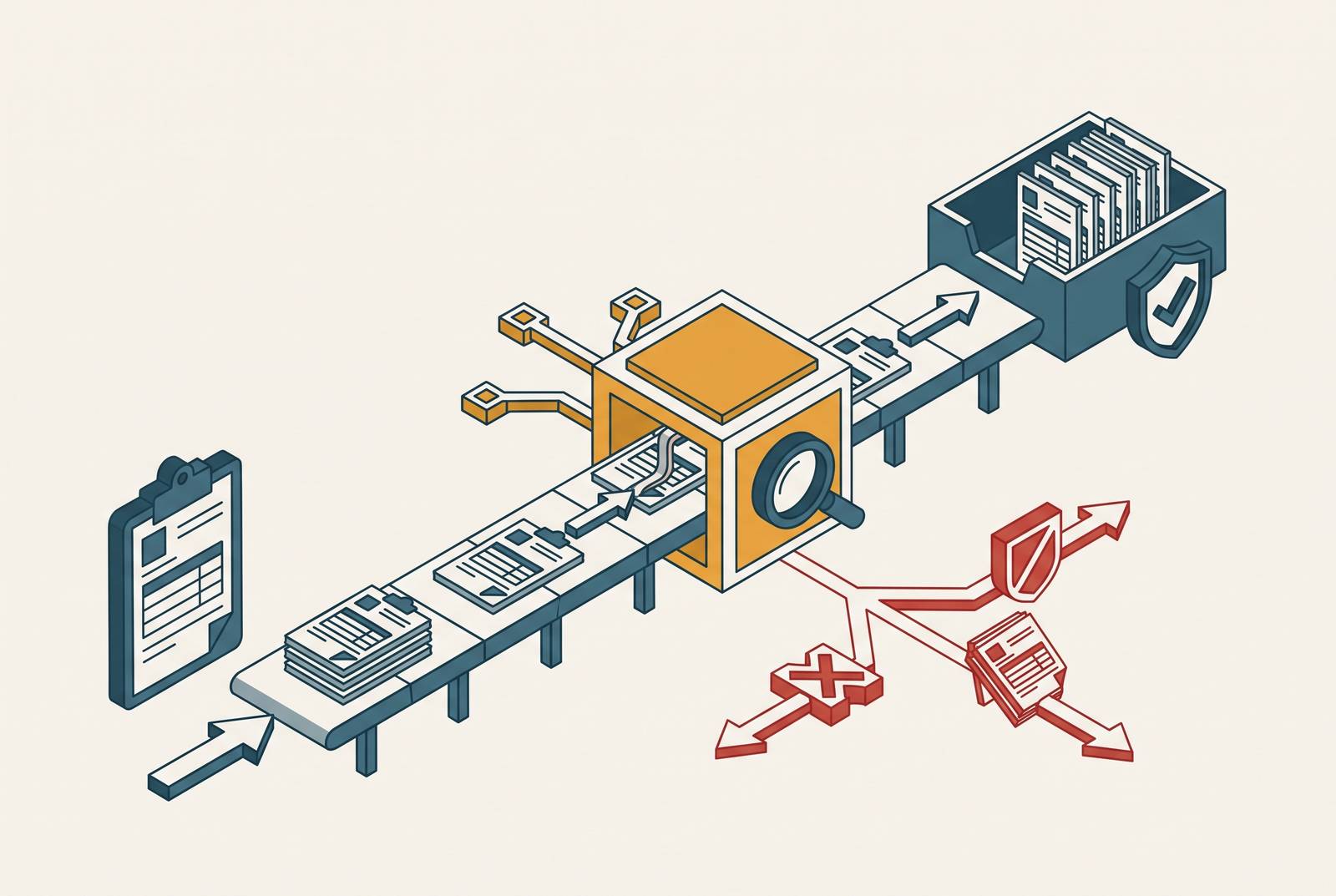
The operational shift this enables is dynamic routing. Lower-risk claims move through normally. Flagged claims get pulled for human review before submission. Nothing runs through a single, uniform queue anymore.
Where AI is producing measurable results in denial workflows
Adoption is broad. A 2025 survey from HFMA and AKASA found 80% of health systems are exploring, piloting, or already running generative AI in revenue cycle management, up 38% in under two years. But adoption and results are two different measurements, and conflating them is exactly how a practice ends up buying AI tools that don't move its denial rate at all.
Black Book Market Research's evaluation of AI in RCM, drawing on input from over a thousand stakeholders, found that 83% of healthcare organizations saw at least a 10% drop in denials within six months of adopting AI. That figure describes organizations that implemented the technology correctly. The broader population still shows denial rates climbing, because most of that spending is going toward documentation tools, not denial prevention specifically. Correlation with adoption doesn't tell you much; correlation with a specific, targeted use of the tool does.
Where governance is in place, meaning trained models, clean underlying claims data, and staff actually equipped to act on what the AI surfaces, predictive analytics deployments have produced meaningful denial rate reductions where implemented effectively. Methodist Health System's implementation pulled 71% of accounts out of staff work queues entirely, equivalent to nearly 14 full-time employees' worth of labor across 56,000 accounts in eight months. On the appeals side, Revecore reports AI-assisted medical record summarization accelerating appeal letter generation by more than 50%. That efficiency gain isn't just about speed for its own sake: it frees clinical staff to spend time on the medical necessity argument instead of hunting through records, and that's what actually moves overturn rates. Nebraska Medicine reallocated a full-time employee within 90 days of deployment while getting better at identifying payer-specific issues.
The pattern across all of this is consistent. Results cluster tightly around organizations that pointed AI directly at denial prevention. Buying AI for some other part of the revenue cycle and expecting denial numbers to fall as a side effect doesn't hold up, and the data above says so plainly.
What predictive AI cannot do and where human expertise remains the deciding factor
The American Journal of Managed Care's 2025 analysis puts it plainly: AI is good at pattern recognition and rules-based automation, but the hardest revenue cycle decisions still need an experienced human making the call. There's a real ceiling here, and pretending otherwise is how practices end up worse off than before they adopted the technology.
Some categories of work sit entirely outside what a model can do. Constructing a genuinely persuasive medical necessity argument requires clinical reasoning a pattern-matching system doesn't have. Payer negotiation and escalation strategy is relational and situational. Filing a regulatory complaint or defending an audit requires judgment about a specific agency's expectations. And figuring out whether a denial reflects a data error versus a mid-cycle payer policy change, the kind UnitedHealthcare rolled out in 2025, takes someone tracking payer behavior over time, not running a script against a rulebook.
Over-relying on AI here carries a real cost. An AI system that generates an appeal letter without clinical expertise behind it produces activity, not recoveries. It can miss the payer's actual stated rationale for denial, pull the wrong supporting elements, and give a practice a false sense that the denial is handled when it isn't.
Prior authorization makes the point sharply. AI automates submission and status checks well. It cannot substitute for institutional knowledge of how a specific payer has behaved historically on a specific procedure type. KFF reported that in 2024, Medicare Advantage insurers issued 52.8 million prior authorization determinations and denied 4.1 million of them, or 7.7%. When providers actually appealed, 80.7% of those denials got overturned, meaning the original decision was wrong more often than not. Yet only 11.5% of denied requests were ever appealed at all. That gap between an 80.7% overturn rate and an 11.5% appeal rate is where a meaningful chunk of recoverable revenue simply disappears. AI can flag the denial. It can't decide, on its own, that the appeal is worth fighting, and then build the argument that wins it.
The hybrid operating model that predictive AI requires to work
None of this works as a single piece of software bolted onto an existing billing process. It requires three things running together: a prediction engine, clean data feeding that engine, and human expertise routed specifically to the exceptions the engine flags. Remove any one piece and the system reverts to the pattern already playing out industry-wide: more AI spending, no corresponding drop in denials.
Data quality comes first, because it has to. HFMA is blunt about this: AI decision-making is only as good as the data behind it, and governance around that data isn't an implementation detail, it's a foundational requirement. A prediction model fed inconsistent registration data produces inconsistent risk scores, full stop.
Integration is the second requirement. Disconnected point tools that live outside the actual claim submission workflow slow things down and dilute whatever return the AI might otherwise deliver. Predictive scoring has to happen inside the existing EMR and clearinghouse workflow, not as a separate process someone checks after the fact.
Then there's the human layer, concentrated on exceptions rather than spread across routine processing. AI handles pattern recognition, eligibility checks, risk scoring, and routing. In-house billing specialists take the flagged claims, the ones where payer-specific knowledge or documentation judgment actually determines the outcome. This is also how a practice builds and keeps institutional memory: knowing how a given payer behaves, what documentation it wants, what argument gets an appeal overturned. That knowledge compounds when it lives with people who stay, and it evaporates when staff turn over and nothing was ever systematized.
HFMA's 2026 framework describes this as automated workflow orchestration: prior authorization, claims edits, eligibility checks, and follow-up all routed dynamically across the revenue cycle instead of dumped into one uniform queue.
Governance underneath all of this is where practices tend to underinvest. Someone has to track denial rates, clean claim rates, cost per claim, and staff productivity on an ongoing basis to confirm the automation is actually changing outcomes, not just changing activity. AI-generated outputs, appeal letters especially, need review for compliance and accuracy before they go out; generation isn't the same as correctness. And staff buy-in decides whether any of this works at all. Teams that trust the AI's output act on it. Teams that don't, quietly work around it, and the investment gets neutralized without anyone officially deciding to abandon it.
What practices should evaluate when assessing whether their current denial management matches how payers now operate
The real diagnostic question isn't whether a practice uses AI. It's where in the workflow the intervention happens: before the claim goes out, or after the payer has already said no. Most practices, if they're honest about it, are still built around the second option.
A few benchmarks make the gap visible fast. HFMA sets 98% as the standard for a high-performing clean claim rate. Most independent and group practices sit somewhere between 75% and 85%, and that spread is direct, measurable evidence of preventable submission errors sitting in the workflow right now. Best-in-class denial rates run below 3%, with below 5% as a reasonable operational target; anything above that threshold means there's real room for upstream intervention. Days in accounts receivable, along with that HFMA figure showing up to 65% of denied claims never get reworked industry-wide, are lagging indicators, but together they show whether a practice is quietly absorbing denial costs instead of fixing the source.
There are also questions worth asking about payer-specific intelligence. Does the billing operation track denial patterns broken out by payer and procedure type? Does anyone know when a specific payer, UnitedHealthcare or Carelon or otherwise, changed its adjudication logic? A denial spike that never gets traced back to a policy change keeps recurring, month after month, because nobody addressed the actual cause.
Practices evaluating a billing partner built around this model should expect a specific set of capabilities: integration with existing EMR and clearinghouse systems that doesn't require ripping anything out and starting over, pre-submission eligibility verification and claim risk scoring built in as standard practice rather than sold as an upgrade, human billing specialists working denials the moment they land instead of batching them for review weeks later, and payer-specific institutional memory that compounds over time, tracking how each payer behaves and which arguments have actually produced overturns.
Combining AI-driven prediction with in-house billing specialists focused on exceptions is the operating model the data supports. It's also the model a practice would need to build internally to get the same results, which means staffing, training, data infrastructure, and ongoing governance that most independent practices don't have the bandwidth to sustain on their own.
Sources
- AI-Driven Denial Prediction: The Next Frontier in Revenue Cycle Management
- Predict, prevent, perform: The AI evolution of denials management
- Where artificial intelligence actually helps in medical billing and revenue cycle management, and where it doesn’t | Medical Economics
- Is AI Automation Actually Reducing Your Revenue Cycle Denials?
- ajmc.com
- Prior Authorization Metrics Provide New Insights into Insurer Practices, but Gaps Remain | KFF
- hfma.org