Patient Billing Collections Best Practices for Physician Practices
Practices that verify coverage before visits and communicate costs upfront collect more reliably.
Patient collections has stopped being a back-office detail and become a question of whether an independent practice stays financially viable. High-deductible health plans have pushed a much larger share of the cost of care onto the patient's own balance rather than the payer's, so the money a practice used to collect in a single claim payment now arrives, if it arrives at all, in smaller pieces from the patient directly. At the same time, claim denial rates have climbed, an MGMA Stat poll found that 60% of medical group leaders reported an increase in their practices' claim denial rates, and only 11% had managed to bring those rates back down. Every denial that goes unresolved either shifts cost onto the patient's balance or turns into a write-off, so the two forces compound: more of the bill depends on the patient, and more of what should have been paid by the insurer ends up contested or unpaid.
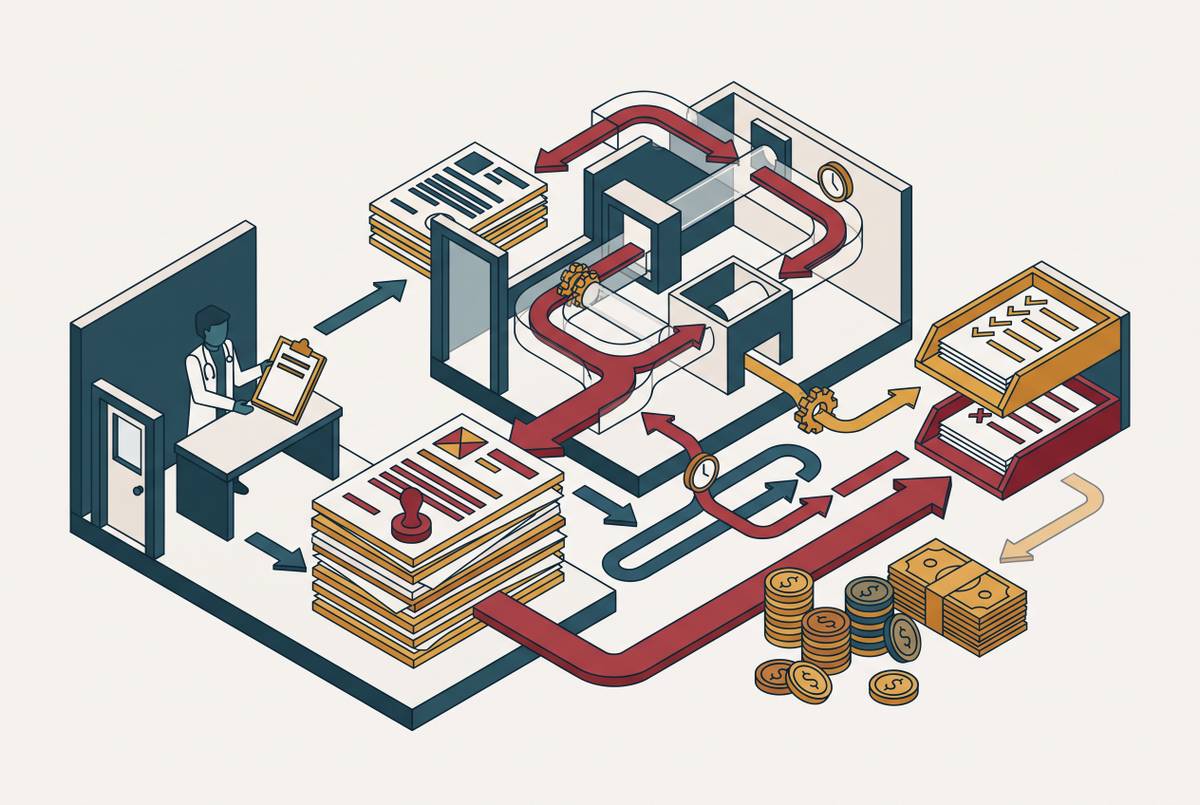
None of this means collections is unsolvable. It means the operational sequence that protects patient-owed revenue, from the eligibility check before the appointment to the final appeal on a denied claim, has more points where it can break, and most practices are only defending a few of them. The rest of this piece lays out that sequence step by step: pre-visit eligibility, upfront financial communication, statement design, payment infrastructure, and denial follow-through. Done consistently, each step reduces the work the next one has to do, and the compounding effect of that discipline is what separates a practice that collects reliably from one that is slowly leaking revenue it earned.
Eligibility verification at the front end and balance disputes at the back end
Collections outcomes are largely decided before the patient ever sits down with the provider. The fix is simple to state and easy to skip under time pressure: run the eligibility check a day or two before the appointment, not weeks in advance and not at check-in, confirming active coverage, deductible status, copay obligations, and coordination of benefits in a single pass. A check run too early misses changes in coverage; a check run only at check-in leaves no time to resolve a problem before the patient is already in the chair.
Done properly, that single pass should answer whether coverage is active as of the service date, what the patient's remaining deductible and out-of-pocket maximum look like, what the copay or coinsurance will be for this specific visit type, how benefits coordinate if the patient carries more than one plan, and whether the provider is actually in-network under the patient's specific plan rather than just contracted with the insurer in general. Real-time eligibility tools built for this now cross-check coverage, coordination of benefits, and patient demographics in one workflow, catching mismatches at the source instead of waiting for a claim to bounce back weeks later with a denial code attached.
The value of this step is that it removes guesswork from everything that follows. A front desk that can cite a patient's actual remaining deductible is having a factual conversation about money; a front desk working from stale or incomplete eligibility data is making an estimate it cannot stand behind, and patients notice the difference when the real bill doesn't match what they were told. What staff does with that verified data, and how soon they share it with the patient, is where the sequence picks up next.
Communicating patient financial responsibility before the visit, not after
Practices that tell patients what they will owe before the visit collect a meaningfully larger share of that money than practices that wait for a statement to do the talking. A patient who expects a bill is more likely to have a card or the cash ready, and less likely to dispute the number later, than one who is caught off guard weeks after the appointment is over. This works because the upfront conversation draws directly on the eligibility data confirmed in the prior step: when a staff member can point to a verified deductible balance and a concrete visit-cost estimate, there's nothing to argue about, because the number came from the patient's own plan.
That conversation at check-in or checkout should cover four things, since collecting at the point of service, rather than waiting for the billing cycle to begin, is cheaper for the practice and more likely to succeed, while every statement that has to go out afterward adds administrative cost and lowers the odds the balance ever gets collected.
Staff who are uneasy discussing money will avoid the topic or bury it in vague language, so a brief, factual script built around the verified number removes that discomfort from the exchange. Prior balances belong in this same conversation, not just the current visit's estimate: a patient standing at the desk, willing to pay, is the highest-probability collection moment the practice will ever get with that balance. Financial hardship policies should be ready to offer at this same point, so a patient who cannot pay in full leaves with a payment plan or a charity care referral. What a patient hears at the front desk sets the expectation they carry home, and that expectation is what the statement needs to reinforce when it finally arrives.
What makes a patient statement prompt payment
Most statements fail to collect money because the statement itself is slow, confusing, and disconnected from what the patient was already told, not because patients refuse to pay. Timing is the first failure point: statements should go out within days of the explanation of benefits posting, not on a fixed monthly calendar. A 30-day statement cycle can mean a patient doesn't see a bill until six or seven weeks after the visit, by which point the appointment is a dim memory and whatever sense of urgency existed has worn off.
Clarity is the second. A statement should show what the service was, what the payer paid, and what the patient owes, in plain language rather than billing codes a patient has no reason to understand. A single, unambiguous amount due with one clear due date collects better than an itemized breakdown that forces the patient to do arithmetic before they can even write a check. The payment channels available, online portal, phone, mail, in person, should be visible directly on the statement; restricting a patient to one channel shrinks how many of them pay. A payment plan option belongs on that very first statement rather than held back until the account has aged, because a patient who sees a manageable installment option immediately is far more likely to act immediately.
A single statement rarely collects a full balance on its own. A planned series, typically a first statement, a follow-up reminder a few weeks later, and a final notice with escalating urgency, consistently outperforms one send followed by an abrupt handoff to a collections agency. Even a well-built statement series will leave some balances unresolved, and a portion of what remains has nothing to do with the patient's willingness to pay. It has to do with whether the patient had a frictionless way to complete the payment, which the next section takes up.
Structuring the payment options that turn willingness to pay into actual payment
A patient who wants to pay but can't find an easy way to do it becomes an aging balance regardless of intent. The mix of payment options a practice offers is an operational decision with a direct effect on how much of that willingness turns into cash in hand, not a convenience feature bolted on for appearances. Online bill pay is now a baseline expectation; a practice that still routes balances under a certain threshold through phone calls or mailed checks is building friction into its own collections process.
Structured payment plans, with automatic payment built in at enrollment, should be available for balances above a defined threshold set low enough to catch the majority of balances patients can't pay in one transaction. Plans that enroll a patient in auto-pay at setup finish at a far higher rate than plans that depend on the patient remembering to make each payment manually, and the terms, the amount, the frequency, and what happens if a payment fails, should be put in writing the moment the patient enrolls. Health savings account and flexible spending account funds should be named explicitly in the payment options a patient sees, since many patients simply forget those accounts exist until someone reminds them.
Credit card on file arrangements, where a patient authorizes the practice to charge a stored card for the remaining balance once insurance has adjudicated the claim, shorten the collections cycle substantially and cut down on how many statements a practice has to send; patient consent and HIPAA-compliant storage of that card data are non-negotiable prerequisites. Financial assistance and charity care policies need to be documented and genuinely easy to apply for, because a patient who qualifies for help but never learns the option exists doesn't become a case of refusal to pay. He becomes an uncollectable balance the practice could have avoided. Even with every one of these options in place, a share of patient balances will remain unresolved for a different reason: the claim underneath them was denied, and nobody appealed it.
Working denials and appeals as part of the patient collections cycle, not separately from it
A large share of the balances that show up on patient statements are inflated or simply wrong, because the claim behind them was denied and the denial was never challenged, leaving the patient on the hook for money the payer should have paid. Treating denial follow-through as a separate back-office function misses this connection: an unworked denial doesn't stay a payer problem, it becomes either an incorrect patient balance or a write-off, and both outcomes are collections failures by a different name.
MGMA's guidance recommends putting someone with the right analytical temperament specifically on denials and appeals, rather than folding that work into the same staff who process routine claims, because the two jobs call for different skills: one is about throughput, the other is about investigation. A prior authorization denial calls for checking whether the authorization was actually obtained, whether it matched the exact CPT code and site of service billed, and whether a peer-to-peer review is available. A rule change helps here directly: CMS-0057-F, effective January 2026, requires Medicare Advantage, Medicaid, and QHP issuers on the federally facilitated exchanges to give specific written clinical reasons for every prior authorization denial, and those stated reasons should be used to build the appeal. A medical necessity denial calls for an appeal that cites the insurer's own clinical criteria and shows how the patient's record meets them, point for point, not a generic letter asserting the care was appropriate.
One detail trips up a surprising number of appeals before they're even reviewed: when a payer has handed prior authorization review to a specialty vendor such as eviCore or Evolent, the appeal has to go to that vendor's own portal or fax line. Filing it to the health plan instead means the appeal never reaches clinical review. Appeal deadlines are set by the payer and are not negotiable, a late appeal is a forfeited appeal no matter how strong the clinical case behind it, so tracking those deadlines from the denial date, not the date the appeal gets written, is a basic requirement of running this process well. A patient should never be billed for a payer-owed amount while an appeal is still open; doing so manufactures a dispute that costs far more to untangle than the appeal itself would have cost to finish. Even when the claims cycle runs cleanly through eligibility, communication, statements, payment options, and appeals, a practice still needs a way to know whether all of it is actually producing results.
The metrics that tell a practice whether its collections operation is working
A practice that isn't tracking the right numbers has no way to tell a collections system that's working from one that's quietly losing money, and that loss is often invisible on a profit and loss statement until the window to recover it has already closed. The net collection rate, the share of collectible charges a practice actually collects after adjustments, is the single most important number in the whole operation and should be reviewed monthly. Days in accounts receivable measures how long it takes to collect after a service is delivered, and HFMA's MAP Keys publish the formula for net days in accounts receivable as FM-1, with HFMA's net collection rate formula published separately in its KPI guidance rather than as one of the 29 MAP Keys; using HFMA's own definitions rather than a practice's internal version keeps the numbers comparable to published industry benchmarks.
The first-pass claim acceptance rate, the share of claims accepted on first submission with no rejection or denial, is the earliest warning sign that something in eligibility, authorization, or documentation has started to slip. Denial rate should be tracked by payer and by denial code rather than as one blended figure, because that level of detail is what reveals whether one specific payer is behaving differently or one specific error keeps recurring across many claims. Point-of-service collection rate, the share of patient-owed money collected at check-in or checkout rather than billed later, tells a practice directly whether the upfront communication and payment infrastructure described earlier are actually happening at the front desk or only on paper. Statement-to-collection lag, the number of days between when a statement goes out and when payment comes in, widens when statement timing, payment friction, or an aging pool of unresolved balances starts to build up, and that widening is usually visible well before the revenue loss shows up anywhere else.
None of these numbers does any good sitting in a report that nobody acts on. Each one needs a threshold attached to it that triggers a specific response, a denial rate that climbs past a set level for one payer should trigger a focused audit of that payer's recent denials, not a general review of billing across the board. The real payoff is cumulative: a practice that runs tight eligibility verification, communicates patient responsibility before the visit, designs its statements to be paid rather than filed away, keeps payment frictionless, and works denials as soon as they arrive ends up with cleaner accounts receivable aging, shorter days in AR, and a higher net collection rate, because each step absorbs problems before they can pile onto the next one. Some of that advantage comes from something harder to put in a spreadsheet: institutional memory of how specific payers actually behave, which ones pay once appealed, which denial codes get overturned reliably, which modifier combinations trigger automated claim edits. That knowledge builds over years, and a practice that loses it to staff turnover ends up relearning the same lessons from zero with every new hire. For practices that cannot staff or sustain that kind of institutional memory on their own, a full-service revenue cycle partner that plugs into the practice's existing EMR and clearinghouse offers a legitimate path forward, one that keeps front-desk workflows intact while adding the payer-specific judgment and denial follow-through the practice could not otherwise maintain. Either way, the lesson holds: practices that run this sequence in full stop losing patient-owed revenue to gaps in their own process, not to patients who were never going to pay.